Deutsch
Kauri (Agathis australis)
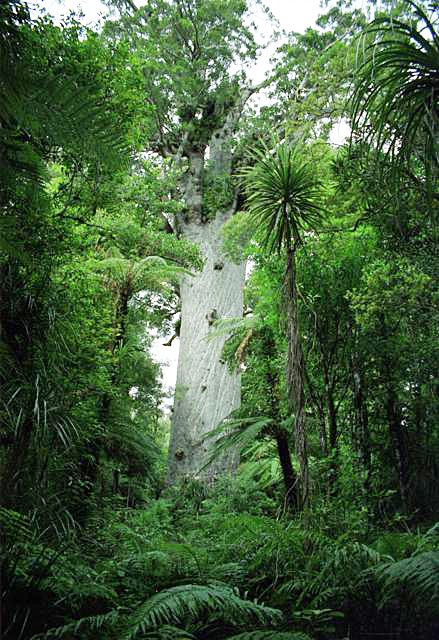
The kauri tree, known by its Māori name Agathis australis, grows only in the northern reaches of New Zealand's North Island and ranks among the most massive and long-lived tree species on earth: some specimens reach a trunk girth of over 13 metres and an age exceeding 1,500 years, with smooth, branchless trunks rising high before the crown opens, and narrow, leathery, evergreen leaves that recall a conifer more than a typical broadleaf tree. When the bark is wounded, a clear to pale-yellow resin seeps out and hardens in the air into firm lumps; the ground beneath old and long-cleared kauri forests also holds abundant fossilised resin, which over thousands to millions of years matured into amber-like, honey-coloured chunks. Kauri belongs to the ancient Araucariaceae family, whose origins reach back to the age of the dinosaurs, making it a living relic of a plant world that once covered much of the southern continents. Since the 2000s, the introduced disease kauri dieback (Phytophthora agathidicida), which attacks the tree's roots, has again seriously threatened the remaining old-growth stands, which is why many walking tracks through the kauri forests today are equipped with boot-cleaning stations.
For the Māori, the kauri is a taonga — a sacred treasure — regarded as the king of the forest and linked in tradition to Tāne Mahuta, god of the forest, who once forced apart earth and sky to let light into the world. Its resin, known as kapia, was chewed like gum, mixed with soot and burned to produce a black pigment for traditional tā moko tattooing, and prized as a reliable fire starter. When European settlers arrived in the 19th century, fossilised kauri gum dug from the ground became one of New Zealand's most important exports, prized for high-grade varnish and linoleum production — an industry that drew tens of thousands of "gum diggers" to the far north of the country and, together with large-scale logging, pushed the kauri forests to the brink of disappearance before comprehensive conservation measures began in the 20th century.
Burned as incense, kauri resin — often sold simply as dammar, given its close chemical kinship to the dammar resins of Southeast Asia — releases a bright, fresh, faintly lemony and resinous-sweet scent that feels light and unclouded, a clear contrast to heavier, darker incenses such as myrrh or agarwood. Owing to its good solubility, the resin has traditionally also been processed into varnish and lacquer outside of incense use; burned, however, it presents above all as bright, transparent, and clarifying. Beyond incense use, kauri resin continues to be traded in several grades, from cloudy, bark-flecked raw resin to clear, almost water-white "kauri gum" of the highest purity, particularly prized by collectors and conservators restoring historic varnished furniture.
Used in the following concerts