Deutsch
Calamus (Acorus calamus)
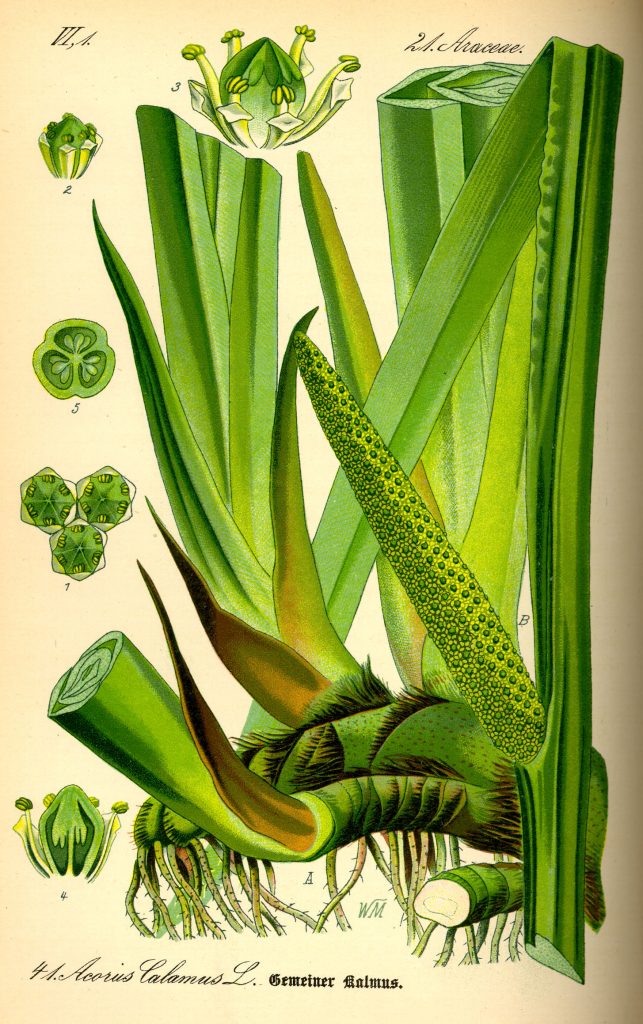
Calamus, also known as sweet flag, is a semi-aquatic perennial marsh plant with sword-shaped leaves and a strongly aromatic rhizome, native to India, central Asia, southern Russia and Siberia, and perhaps Eastern Europe, as well as China and Japan. It was introduced to Western Europe and North America for medicinal purposes and thrives along the edges of ponds, rivers, marshes, and wetlands. The sword-shaped leaves, growing up to a metre long, release a pleasantly spicy fragrance when crushed, and the creeping, ringed rhizome can form extensive stands over time. Botanists distinguish diploid, triploid, and tetraploid strains of the plant, which differ, among other things, in their content of the compound β-asarone. Crushing a piece of the rhizome releases a warm scent reminiscent of cinnamon and ginger, arising from a complex mixture of phenylpropanoids and terpenes. In some regions, the dried root is still crushed and used as a natural insect repellent in textiles and storage rooms.
Calamus ranks among the oldest known medicinal and ceremonial plants, already mentioned in the Egyptian Chester Beatty Papyrus VI (around 1300 BC), where it appears as an ingredient in a bandage used to soothe stomach ailments, even though the plant was likely not native to Egypt. Among numerous Indigenous peoples of North America, including the Ojibwe, who knew the root as "wiike," it was traditionally chewed to fight fatigue, sharpen mental clarity, and carried on long journeys as a protective remedy. In Europe, calamus was often added to wine, and the root remains one of the possible ingredients of absinthe; crystallized, it is known as "German ginger," and its oil has traditionally been used to flavor pipe tobacco. Some scholars also identify calamus with the biblical "kaneh bosem," an ingredient of the sacred anointing oil described in the Book of Exodus (30:23). In ancient Greece and Rome too, the root was known as a remedy for stomach and eye ailments, and Dioscorides described it in detail in his "De Materia Medica," one of the most influential works of ancient pharmacology.
Burned as incense, calamus releases a warm, sweetly spicy, woody root scent with a faintly bitter, ginger-like sharpness that unfolds slowly as it heats and lingers well afterward. It is traditionally associated with mental clarity, protection, and grounding, and used for cleansing as well as strengthening memory and concentration — qualities that recur remarkably consistently across cultures, from ancient Egyptian healing recipes to North American travel traditions. Some incense traditions of South and Central Asia also use calamus deliberately in cleansing rituals before important ceremonies, believing its smoke creates a clear, focused state of mind.
Used in the following concerts