
 Deutsch
Journal — Literature
Scent and Literature
The hardest sense to describe has, despite that difficulty, produced some of the most singular pages in world literature.
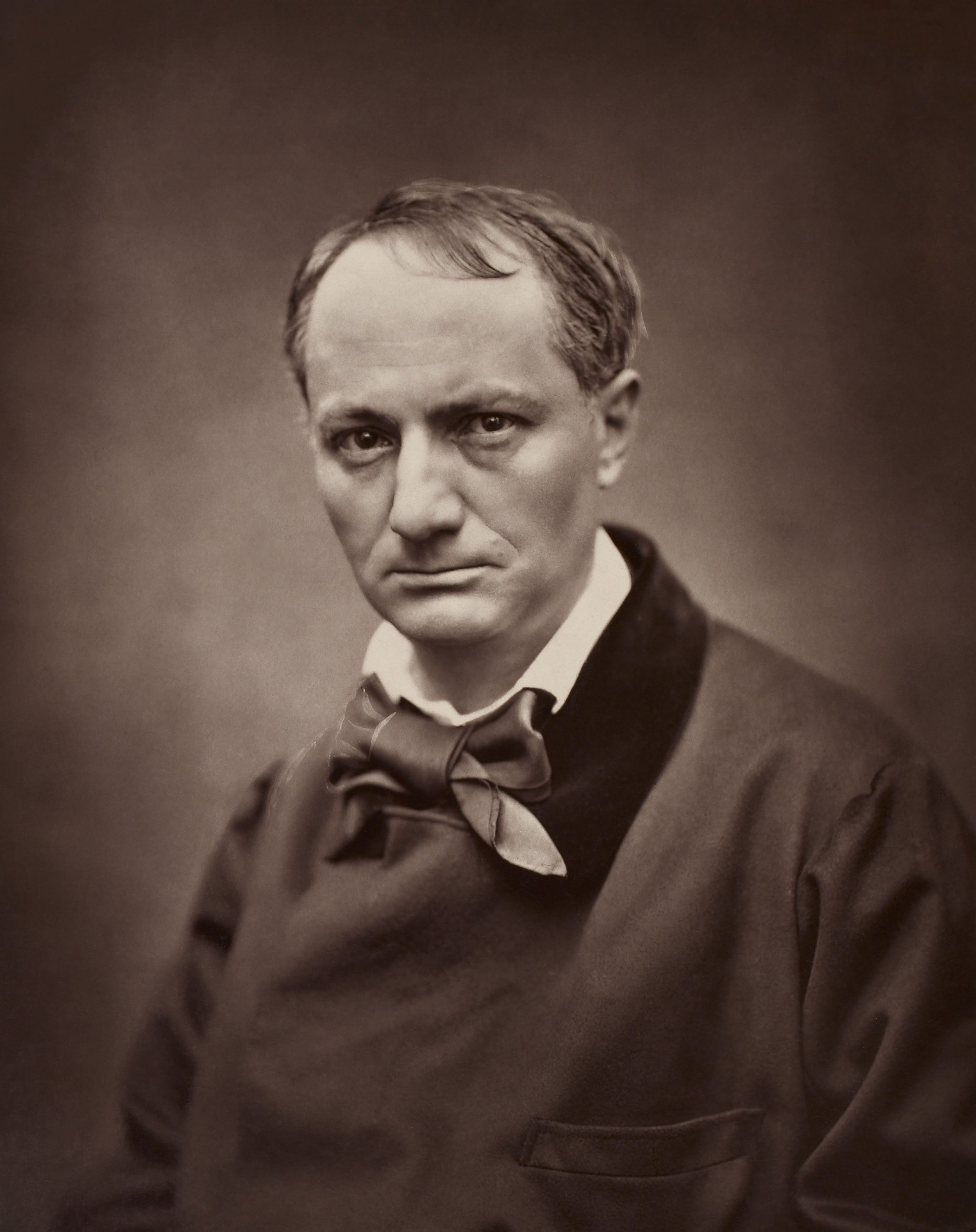
Charles Baudelaire, circa 1862 — Photo: Étienne Carjat, public domain, via Wikimedia Commons
Long before Baudelaire, scent was already central imagery in biblical love poetry: the Song of Songs, likely composed in the first millennium before our era, describes the beloved through an abundance of scent metaphors — myrrh, spikenard, henna, ‘a garden locked’ full of spices — in which fragrance is not decorative accessory but a direct emblem of desire itself. This close bond between scent and erotic language runs, often unnoticed, through large stretches of world literature up to Baudelaire and beyond.
No poet placed scent as systematically at the center of his poetics as Charles Baudelaire. His programmatic sonnet Correspondances, published in 1857 in Les Fleurs du mal, casts nature as a ‘temple’ whose living pillars let ‘confused words’ escape, while ‘scents, colors, and sounds answer one another’ — one of the earliest and most influential literary formulations of that synesthetic kinship between the senses, taken up directly by later Symbolists such as Rimbaud and Mallarmé.
Baudelaire did not stop at theory. In La Chevelure he celebrates a lover’s hair as a vehicle for travel — ‘I breathe for a long time the scent of your hair,’ he writes, letting it carry him to Africa, to distant harbors, into entire imagined worlds; in Le Flacon he describes how an old, half-empty perfume bottle, opened after years, releases an ‘intoxicated soul’ and an entire lost past — an anticipation of Proust’s madeleine, more than sixty years before Proust published his novel.
Where Baudelaire celebrates scent, Joris-Karl Huysmans drives it to exhaustion in his 1884 novel À rebours (Against Nature): his protagonist Des Esseintes, a decadent aesthete who has withdrawn entirely from society, experiments in a laboratory of his own with perfume blends, composes ‘scent symphonies’, and arranges raw materials by their supposed musical correspondence — a fictional figure who takes exactly the scent-sound analogy that Septimus Piesse had coined as a technical term a few decades earlier and inflates it into a caricature of an entire way of life.
A century later, Patrick Süskind pulled off the rare feat, in Perfume (1985), of building an entire novel around the sense of smell itself: his protagonist Grenouille, born without any scent of his own but gifted with a superhuman ability to smell, becomes a murderous perfumer seeking to distill the ‘perfect’ human scent. Süskind’s greatest achievement lies less in the plot than in the language itself: he describes smells with a precision and richness of vocabulary that shows how much literary potential lies in a sense that language otherwise notoriously serves badly.
These examples — Baudelaire, Huysmans, Proust, Süskind — are separated by more than a century, yet they share a common observation: scent resists direct description almost always, and can almost only be captured by detour — through memory, through comparison, through an entire story told around it. Perhaps that is exactly why scent, unlike in the visual arts or in music, can never be directly depicted in literature but only ever narrated — and why exactly this indirection has produced so many of the most singular pages in world literature.
An incense concert like Incense of Music stands, without naming it, in exactly this tradition: it attempts, by other means, to do what took Baudelaire an entire sonnet and Süskind an entire novel — to make the most fleeting of all senses graspable, for a moment.