
 Deutsch
Journal — Science
Why Is Lavender a Sedative?
Linalool and linalyl acetate appear to act on the same system as some anti-anxiety medications — with clinical evidence that goes beyond simple aromatherapy.
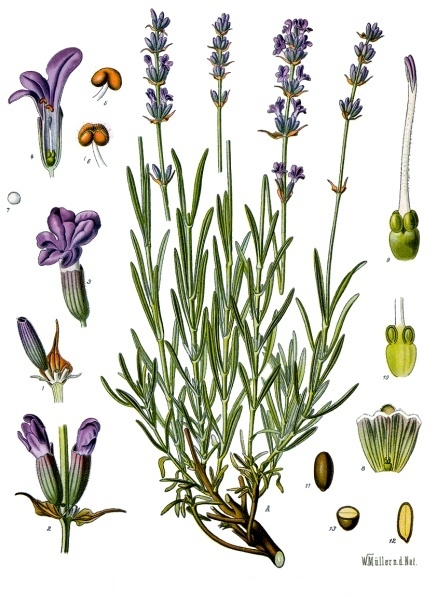
Lavandula angustifolia — illustration: Köhler’s Medizinal-Pflanzen (1887), public domain, via Wikimedia Commons
Crush a lavender flower and most of what reaches the nose is linalool and linalyl acetate — two related compounds that make up the bulk of the essential oil, and that turn out to do more than just smell calming. In animal studies and a growing number of controlled human trials, both compounds appear to act on much the same system as some anti-anxiety medications: they enhance signaling through GABA-A receptors, the brain’s main inhibitory switch, and modulate certain calcium channels involved in nerve excitability.
The clearest clinical evidence comes from an oral lavender oil preparation, marketed as Silexan, tested against generalized anxiety disorder in several placebo-controlled trials; in some, its effect size matched low-dose lorazepam, a benzodiazepine, without the sedation, dependence risk, or withdrawal that come with it. Simple inhalation has weaker but still measurable effects — a frequently cited study in a dental waiting room found patients exposed to ambient lavender scent reported less anxiety than a control group, with no difference in how alert they otherwise felt.
None of this was demonstrated by chemists first. Lavender’s name is often traced to the Latin lavare, to wash, from its use in Roman bathwater, and it was strewn on floors through the Middle Ages as much for its calming reputation as for masking odors. At Incense of Music 12, in March 2017, we burned lavender alongside labdanum — a pairing that turns out to make some chemical sense: one calms while it clears the room, the other, a resin combed from the same rockrose family, does the opposite, warm and slightly animalic.