
 Deutsch
Journal — Music & Scent
Debussy’s Piano Music — What Plant Might Fit?
A single afternoon at the 1889 Paris World’s Fair was enough to change Debussy’s music forever — and offers, more than a century later, a surprisingly precise answer to the question of a fitting scent.
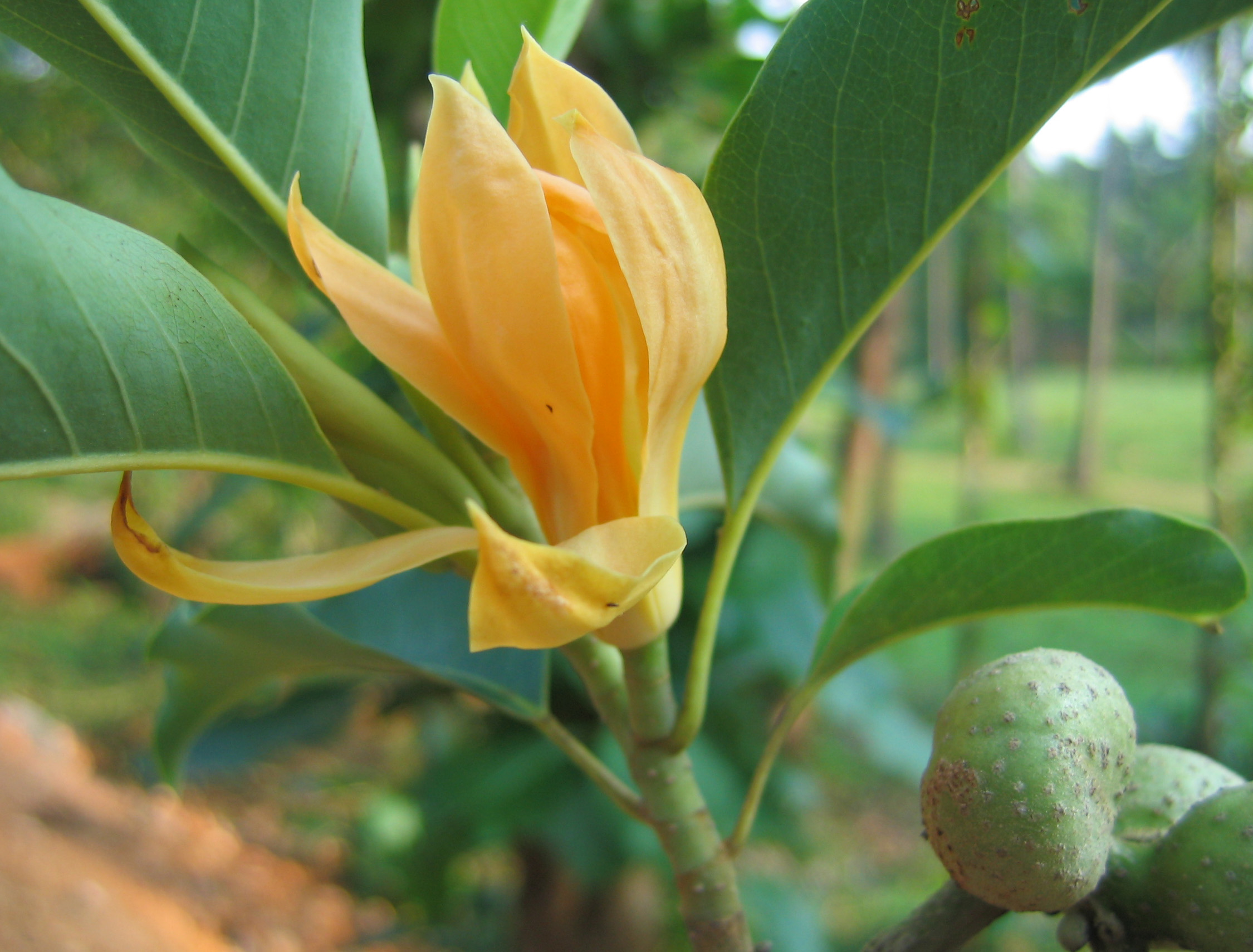
Magnolia champaca, the champaca flower — Photo: Vinayaraj, CC BY-SA 3.0, via Wikimedia Commons
In the summer of 1889 the twenty-seven-year-old Claude Debussy repeatedly visited the Javanese pavilion of the Paris World’s Fair, where a gamelan orchestra from what was then the Dutch East Indies performed — metallophones, gongs, interlocking, overlapping rhythms, a sound world that had almost nothing in common with the European art music of his time. Debussy himself later noted that Javanese counterpoint made ‘Palestrina’s look like child’s play’. This encounter never let go of him.
Its traces are unmistakable in Pagodes, the first piece of his 1903 piano collection Estampes: pentatonic scales, hovering, unresolved sonorities, layered textures stacked without the usual harmonic drive of Western music — a deliberate approach to the Javanese sound ideal, without copying it. Similar sound worlds run later through La Mer and large parts of Images, that typically Debussyan suspended state between clarity and dissolution, between a clearly recognizable image and its blurring.
Were one to set a plant beside this music, the flower that plays a central role in Javanese culture itself all but suggests itself: the champaca flower, Magnolia champaca, cream-white to orange-yellow, with a heavy, honey-sweet, faintly fruity scent that has been used across South and Southeast Asia for centuries for temple offerings, for perfumed hair oil, and for ritual garlands — in Java itself it is among the trees most commonly planted at sacred sites.
It is telling that Debussy never visited Java — Estampes, the collection of three piano pieces headed by Pagodes, is, taken as a whole, a collection of imagined places: the Javanese soundscape is followed by La soirée dans Grenade, a Spanish-flavored piece by a composer who, at the time of composing it, had likewise never been to Spain, before Jardins sous la pluie closes the cycle with a familiar French garden in the rain. Debussy composed ‘elsewhere’, in other words, largely secondhand, from sounds, images and accounts rather than his own travel experience — a working method very familiar to perfumery, where likewise few compositions named ‘oud’ or ‘saffron’ come from perfumers who have ever set foot at their geographic point of origin.
The parallel lies not only in geographic origin. Champaca scent is considered, in perfumery, ‘heavy and slow to volatilize’ — it unfolds slowly, lingers long in the air, without organizing itself into clearly distinguishable phases, not unlike the way Debussy’s harmonies rarely progress clearly from major to minor, from tension to resolution, but instead remain suspended in between. Both — scent and music alike — resist the linear, goal-directed structure that Western ears and Western noses often expect.
It was not entirely a coincidence that Debussy appeared on the program of Incense of Music 51 in June 2021, when Yannick Rafalimanana, on the occasion of the project’s very first digital collaboration, played the composer’s piano works on a historical 1896 Bechstein — the very type of instrument Debussy himself composed on. A coincidence of programming, certainly, but one that shows how persistently certain connections between sound and scent reassert themselves the moment one begins to look for them.
In the end, the question of which plant ‘fits’ Debussy remains, of course, speculative — music cannot be translated into scent the way a text is translated into another language. But rarely does the answer lie this close at hand: a flower from exactly the sound world that changed a young Parisian composer forever, on a summer afternoon in 1889.