Deutsch
Musk Mallow (Abelmoschus moschatus)
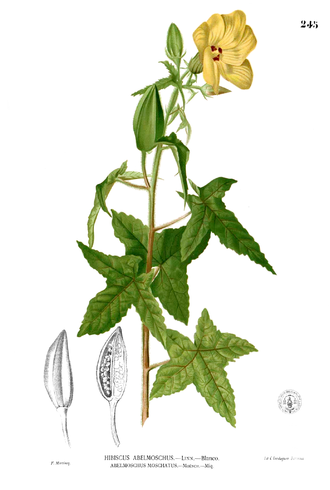
Abelmoschus is a genus of roughly fifteen to twenty flowering plant species in the mallow family, Malvaceae, native to the tropics and subtropics of Africa, Asia, and northern Australia. The genus was separated from the closely related Hibiscus in the late eighteenth century, chiefly on differences in how the seed capsule splits open at maturity. Its best-known member for fragrance is Abelmoschus moschatus, commonly called musk mallow or ambrette — a bushy annual or short-lived perennial herb reaching one to two metres, with large, pale-yellow, hibiscus-like flowers marked by a dark maroon centre. It is cultivated across India, Indonesia, Egypt, Madagascar, and China. The plant's fragrance sits not in its flowers but in its seeds: small, kidney-shaped and dull brown, borne inside a bristly, ribbed capsule. Crushed, they release a warm, musky odour carried mainly by ambrettolide, a macrocyclic lactone that remains one of the very few naturally occurring compounds to closely resemble animal musk.
Because true musk — taken from the abdominal gland of the musk deer — was costly, difficult to obtain, and increasingly restricted for conservation reasons, ambrette seed became one of the most valued plant-based substitutes across South and Southeast Asia and the Middle East, prized since antiquity for smelling convincingly close to the animal original. In Ayurvedic and Unani medicine it has long held a place as a warming digestive remedy and a general tonic, and the seeds are still chewed in parts of India today as a breath freshener after meals. In Yemen and other parts of Arabia, crushed ambrette seed was traditionally added to coffee alongside cardamom to perfume the brew, and across South Asia it found its way into betel-leaf (paan) preparations. In perfumery it became, and remains, indispensable as a fixative — a substance that slows the evaporation of more volatile scents — prized precisely because it offered an ethical, plant-derived route to a note that had for centuries been available only from an animal source.
Burned as incense, ambrette seed gives off a warm, sweet, distinctly musky scent with a soft animalic depth and a faint wine-like, fruity undertone that perfumers often note in the raw seed. It rarely stands alone in an incense blend; instead it is valued as a base note that lends body, warmth and a sense of skin-like intimacy to lighter floral or resinous ingredients burned alongside it, much as it does when used as a fixative in liquid perfumery. Its musky character, without any animal origin, has made it a natural choice wherever a blend calls for warmth and sensuality rather than brightness or clarity.
Used in the following concerts