Deutsch
Agarwood (Aquilaria spp.)
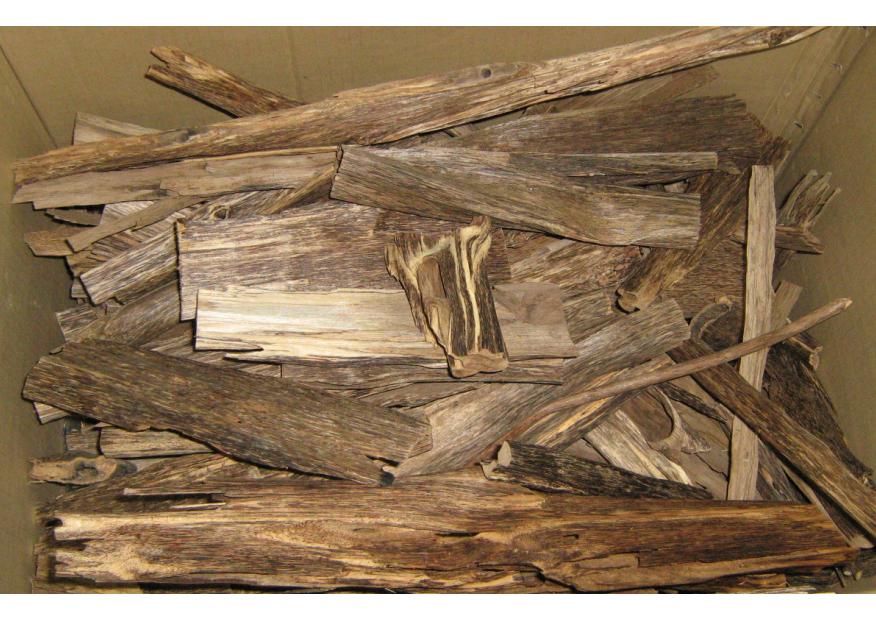
Agarwood does not come from a single tree species but from roughly fifteen species of the genus Aquilaria, native to the rainforests of Southeast Asia — from India and Bangladesh through Myanmar, Thailand, Laos, Cambodia, and Vietnam to Indonesia and the Philippines. What makes it remarkable isn't the tree itself, a tall, unremarkable member of the thymelaeaceae family, but a mysterious defence process within its heartwood: when the tree is stressed by a particular mould, mechanical injury, or insect infestation, it responds by producing a dark, dense, resin-saturated wood — and it is precisely this transformed wood that becomes prized agarwood, while unwounded heartwood remains nearly odourless and worthless. Since the process can take decades in the wild and wild populations of nearly all Aquilaria species are now endangered through overharvesting and protected under CITES, naturally matured agarwood ranks among the rarest and most expensive natural materials on earth.
For millennia, agarwood has been burned in religious ceremonies across Buddhism, Hinduism, Christianity, and Islam, believed to purify the air, calm the mind, and open a connection to the spiritual world; it appears in the Old Testament under the name aloeswood as both incense and perfume. In Japan, the prized wood, known there as jinkō, gave rise from the medieval period onward to the distinct art form of kōdō, "listening to fragrance," in which trained participants distinguish the finest nuances between wood samples in contemplative silence. It has also long been closely tied to wealth and status — given as a treasured diplomatic gift between rulers, burned at weddings and in honour of distinguished guests across the Middle East, and, to this day, the prized base note of "oud" perfumes, which rank among the most expensive in the world.
Burned, agarwood releases an exceptionally layered aroma — deep, woody, and aged, with notes of honey, amber, and leather, and a faint, almost animalic undertone that can vary considerably with the wood's origin and degree of resinification. It is typically burned as small wood chips on glowing charcoal, its scent unfolding slowly and in shifting facets rather than revealing its full depth at once. Connoisseurs describe a fragrance that transforms over several minutes — one reason agarwood is traditionally burned alone, in quiet contemplation, rather than blended with other materials.
Used in the following concerts