Incense of Music 71/ Biłat + Jasinska, Matsuno
Incense of Music 71
A multisensory concert – Friday, 27th March 2026, 8 pm
Julia Biłat: cello
Zuza Jasinska: voice
Keisuke Matsuno: guitar, electronics
Incense burning: tba
PANDA Platforma in der Kulturbrauerei, Knaackstr. 97, 10435 Berlin
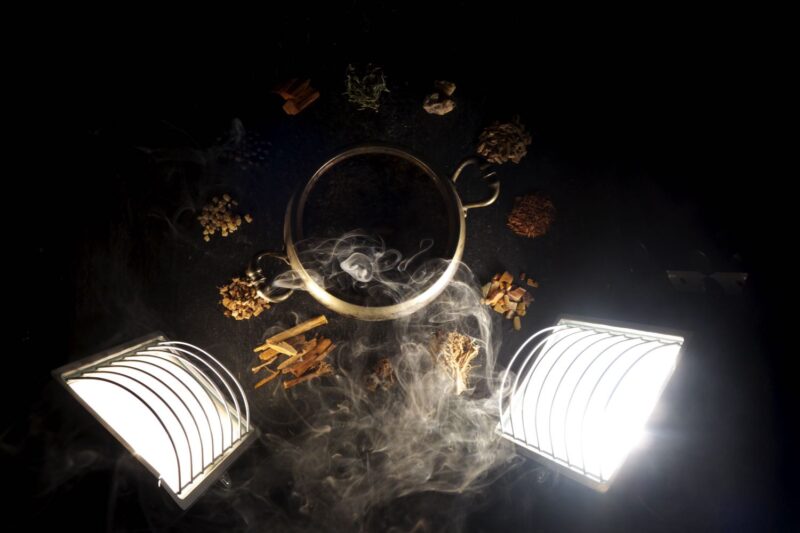
Join us for a unique sensory experience that brings together two distinct musical voices for a special double set. Julia Biłat is a Berlin-based cellist, composer, and sonic explorer. In her solo performances, she transcends the conventional concert format, weaving together deeply personal cello improvisations with elements of performance art. Her work is a profound exploration of the body, voice, and space, creating a captivating and introspective sound world. Zuza Jasinska & Keisuke Matsuno present a dialogue of voice and guitar. Zuza, a vocalist and composer, blends folk-pop intimacy with jazz inflection and the fearless spirit of experimental improv. Her evocative voice is met by Keisuke's intricate and sensitive guitar work, creating a sound that is both delicate and powerful. A carefully selected incense will be curated to complement the auditory journey, deepening the atmosphere of the evening. The specific scent will be revealed soon. Let the music fill your ears and the fragrance transport your mind.

Julia Biłat is a Berlin-based, classically trained cellist, improviser, and composer. She is dedicated to her exploratory, genre-bending practice at the intersection of improvisation, composition, and performance art. As a cellist, she participates in various classical, jazz, improvisation and performance projects such as Stegreif.Orchestra, Camila Nebbia's The Hanged One or Fabiana Striffler's Archiotic Quintet. Commissioned by Stegreif.Orchestra, she has composed and co-directed several productions (most recently, #bechange Hildegard von Bingen, 2022/2023). In recent years, Julia Biłat has focused on a solo format, in which she combines performance art with solo cello improvisations, creating structures where the body and voice - along with spatial awareness - play an important role. With her solo project she has performed at the Butohpolis Festival in Warsaw, Poland, at the Into The Open Festival in Kuehlhaus, Berlin and at the Intermittenze Festival in Catania, Italy among others.

Zuza Jasinska: "I am a vocalist based in Berlin, Germany. I compose and sing music like folk-pop, jazz, and experimental improv. I I was raised in Poland, in a city called Toruń, nestled by the Vistula River and famous for its gingerbread. There’s a moment caught on camera from when I was just a little bean—my mom turning to my dad and saying, “I’m telling you, she’ll be singing.” And here we are. I shaped my style by mimicking the sounds around me—it got so out of hand that I started calling myself a chameleon. Copy, paste, repeat. I loved it. Today, I sound more like me. I stopped copying, and it turned out pretty well. For now, that’s it. I’ll add more later."
Keisuke Matsuno plays the guitar. And he creates sounds & noise through self-made analog audio signal processing. He also writes instrumental songs about the small things in life. And does other things that inspire him. What inspires you? Keisuke plays solo, with his trio (w/ Andrea Parkins & Steve Heather), his quartet (w/ Evi Filippou, Alexander Binder, Hanno Stick), Wood River, Hues, Smashing Humans, The Killing Popes, Jim Black Quartet, John Zorn’s Bagatelles, Trio Schmetterling,…
https://keisukematsuno.tumblr.com/
Incense of Music 69/ Younes, Hamedi
A multisensory concert – Friday, 30th January 2026, 8 pm
Mevan Younes, Buzuq
Elham Hamedi, Kamancheh
Fabio Dondero (Incense): Myrrh, Lavander
PANDA Platforma in der Kulturbrauerei, Knaackstr. 97, 10435 Berlin

Echoes from Mesopotamia
A Musical Dialogue Prepare for a musical journey to the cradle of civilization, where the spirit of ancient Mesopotamia is channeled through the strings of two master musicians. Mevan Younes on the buzuq and Elham Hamedi on the kamancheh engage in a profound dialogue, exploring the vast emotional landscape of Kurdish and Mesopotamian heritage. The evening begins with the resonant, metallic pluck of the buzuq. Mevan Younes coaxes intricate, rhythmic patterns from its long neck, each note buzzing with a vibrant, earthy energy. His playing is both percussive and melodic, building complex architectures of sound that recall the sun-baked landscapes and resilient spirit of its people. The buzuq speaks in the language of fire, dance, and the unyielding passage of time. Then, the voice of the kamancheh enters. Held upright and bowed with profound sensitivity by Elham Hamedi, its sound is the evening's response to the buzuq's day. It is a voice of poignant beauty and lyrical sorrow—a soaring, weeping melody that seems to touch the very soul. Elham coaxes microtones and delicate ornaments from its strings, navigating the intricate pathways of Kurdish maqams (modes) with breathtaking precision. The kamancheh speaks of longing, of history, and of the deep, flowing rivers of the region. Together, they do not merely play in unison; they converse. They argue, they mourn, they celebrate. Through composed pieces and spirited improvisations, they explore the rich tapestry of their shared musical heritage. The buzuq lays down a rhythmic, harmonic foundation, over which the kamancheh paints stories in shades of joy and melancholy. Their interplay is a testament to the diversity and depth of this ancient tradition, at once fiercely rhythmic and heartbreakingly tender. A Note on the Atmosphere: Enhancing this auditory journey, a subtle fragrance lingers in the air—the sacred, resinous depth of myrrh echoing the buzuq's ancient roots, and the ethereal, herbal calm of lavender mirroring the kamancheh's soulful cry. This scent is but a whisper, a ghost in the hall, designed to deepen the immersion into the soundscape without ever distracting from its power. This is more than a concert; it is an invitation to witness a living tradition. It is a rare opportunity to experience the echoes from Mesopotamia, not as relics from a museum, but as a vibrant, evolving conversation between two exceptional artists and their instruments.

Mevan Younes
Born in the multicultural city of Al Hassak north of Syria, the musician has become specializes in a traditional oriental instrument with Buzuq. Already at the age of seven began his musical education at his Father, where he initially learned mainly the Kurdish music. Later, Mevan then sat at the College of Music in Damascus Damascus Higher Institute of Music) continued his musical education and completed his studies under the Care of Professor Askar Ali Akbar in 2011. During this time he also took up the work as Buzuq teacher on. Mevan is a member of the Syrian Arab National Orchestra and has been a guest in the past numerous events such as the Morgenland Festival in Osnabrück or the Rskilde Festival in Denmark. Involvement in international events led Mevan into various countries such as Turkey, Tunisia, Ghana, Kurdistan, Denmark, France and Germany. Since 2015, Mevan Younes lives in Germany Greater Berlin, where he has his other pursued musical education and together in various bands and ensembles is active. Among other things, Mevan is part of the Ugarit trio and the Berlin Orient ensemble.

Elham Hamedi
(1987, Mahabad) is a Kurdish musician, singer, and composer specializing in the Persian kamancheh. She studied Classical Persian Music at the University of Art in Tehran and later taught at the Diyarbakir Academy of Music. Since 2020, she has been studying composiMon at the Barenboim-Said Academy in Berlin with Stefan Winkler and Arnulf Herrmann. Her performances as both an instrumentalist and singer have taken her to Malaysia, the Middle East, Russia, and Europe, including a recent appearance in Oslo and a live RBB broadcast from Berlin’s Luisenkirche. In 2019, she received second prize in the ISAM ComposiMon CompeMMon, and in 2024, she presented a widely acclaimed solo recital at the Ostheimer Organ FesMval.

Myrrh: The Sacred Resin
As a plant, myrrh comes from small, thorny trees of the genus Commiphora, native to the dry, arid regions of Northeast Africa and the Middle East. The treasured resin is not the wood or sap, but a fragrant gum that naturally oozes from the bark to heal wounds. Harvesters make deliberate cuts to encourage more of this valuable secretion, which hardens into tear-shaped, reddish-brown granules. As an incense, myrrh is legendary. When burned, it releases a rich, complex aroma that is simultaneously earthy, bittersweet, and slightly medicinal. Its scent is deeply ancient and spiritual, evoking images of temple rites, sacred ceremonies, and caravan routes. Unlike floral scents, myrrh provides a profound, grounding base note. It is known for its purifying, meditative qualities, and has been used for millennia to create a solemn, contemplative atmosphere.

Lavender: The Calming Bloom
As a plant, lavender is a beautiful and resilient shrub native to the Mediterranean region, easily recognized by its slender, silvery-green leaves and tall spikes of tiny, vibrant purple flowers. It thrives in sunny, rocky landscapes, and its iconic colour is named after the plant itself. The essence of lavender is contained in tiny oil glands on its flowers, which release their fragrance when touched or warmed by the sun. As an incense, lavender offers a distinctly herbal, floral, and slightly sweet aroma. When burned, its scent is calming and clean, known to ease the mind and promote a sense of peace and relaxation. Unlike heavy, resinous incenses, lavender's smoke is often lighter and more airy. It is used to purify a space, relieve stress, and encourage restful sleep, making it a staple for creating a serene and balanced atmosphere.

Deutsch