
 Deutsch
Journal — Science
Why the Human Sense of Smell Fell Out of Favor
An estimated sixty percent of our olfactory receptor genes are switched off. A trail that runs through genetics, color vision, and the nineteenth century.
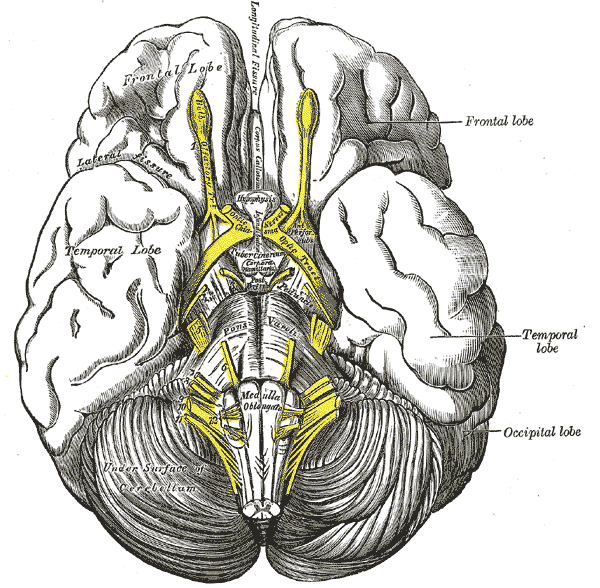
Olfactory bulb and tract — illustration from Gray’s Anatomy (1918), public domain, via Wikimedia Commons
Of the roughly eight hundred olfactory receptor genes stored in the human genome, a majority — commonly put at somewhere around sixty percent — are pseudogenes: broken copies, switched off by mutations, that no longer produce a working receptor. Compare that to a mouse, where the great majority of the same gene family still functions, and the pattern looks less like decay and more like abandonment.
One of the more debated explanations ties this directly to color. In a widely cited 2004 study in PLOS Biology, Yoav Gilad and colleagues found that primate lineages which evolved full trichromatic vision — the ability to see red distinctly from green, not just the blue-yellow contrast most mammals manage — lost olfactory receptor genes at a markedly faster rate than lineages that kept only two-color vision. The suggestion was that once a primate could spot a ripe red fruit against green leaves from a distance, the nose became a slightly less essential source of the same information, and evolution stopped bothering to maintain every receptor gene precisely. Later work has pushed back on how direct that link really is, and the debate is not settled.
The idea is older than the genetics, though. In the nineteenth century, the French anatomist Paul Broca divided mammals into “macrosmatic” and “microsmatic” — strong-smellers and weak-smellers — and noticed that the olfactory regions of the brain shrank, relative to everything else, as the neocortex expanded in primates and especially in humans. Broca’s own explanation leaned on some now-outdated ideas about free will and instinct, but the basic observation held up: proportionally, almost no mammal devotes less of its brain to smell than we do.
None of this means human smell is negligible — trained noses can still distinguish on the order of a trillion different odor mixtures, by one influential estimate. It means, rather, that of all our senses, smell is the one evolution seems to have let coast, quietly, while vision and reasoning took over the jobs it used to do alone. It is a fitting origin story for an incense project: if the nose had to fight harder to be noticed, this whole undertaking is, in a small way, an argument for paying it that attention back.