
 Deutsch
Journal — Science
How Does the Human Sense of Smell Work?
Over a thousand different receptor genes, a direct line into memory, and the ability to distinguish more than a trillion smells — the most underrated sense is also the more complicated one.
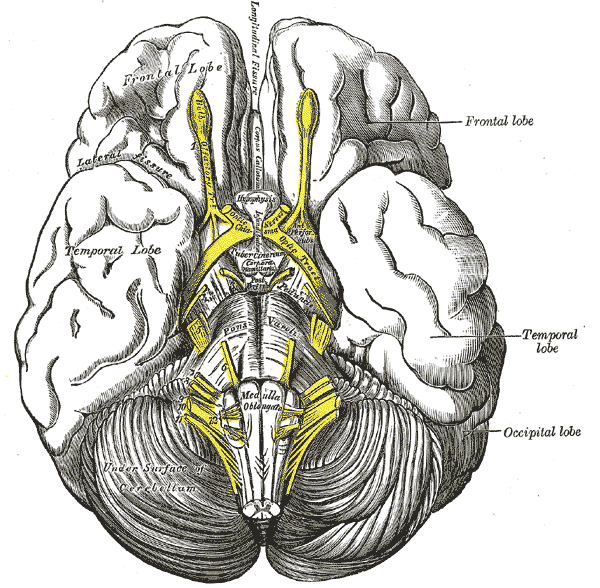
Diagram of the olfactory pathway, from Henry Gray, Anatomy of the Human Body (1918) — Illustration: Henry Vandyke Carter, public domain, via Wikimedia Commons
Every breath carries scent molecules across the nasal mucosa up to a small, coin-sized patch high in the roof of the nose: the olfactory epithelium, a few square centimeters on which several million olfactory sensory cells sit tightly packed. Each of these cells carries only a single type of olfactory receptor on its surface — in humans, around 400 functional genes code for that many distinct receptor types, considerably fewer than the roughly 800 genes the genome sets aside for olfactory receptors altogether, since over half of them have, over the course of human evolution, degraded into non-functional pseudogenes.
This system was only discovered in 1991, when Linda Buck and Richard Axel, in a paper now considered legendary, identified the gene family of olfactory receptors — one of the largest gene families in the entire human genome. For this discovery both received the Nobel Prize in Physiology or Medicine in 2004, more than a decade after the original publication, a sign of how long it took for the full scope of the discovery to be appreciated.
A combinatorial principle is decisive here: a single scent molecule rarely activates only one receptor type, but usually a characteristic pattern of several receptors activated simultaneously, each at a different intensity. The brain reads this pattern like a code — with only around 400 different ‘letters’, a practically inexhaustible number of different ‘words’, that is, perceived smells, can be formed this way. A widely cited, if methodologically disputed, 2014 study calculated the ability to distinguish more than a trillion different scent combinations — far more than the eye can distinguish in colors or the ear in tones.
Anatomically, the path these signals take is also unusual. Every other sense — sight, hearing, touch, even taste — is first routed through the thalamus, a kind of central relay station, before reaching consciousness. The olfactory pathway, by contrast, runs directly from the olfactory bulb to the amygdala and hippocampus, the centers for emotion and memory — with no such detour at all. This anatomical shortcut is considered one of the most plausible explanations for why smells are remembered so much more immediately and with such emotional density than images or sounds.
What we colloquially call ‘taste’ is, moreover, mostly smell: the famous pinched-nose test shows it at once — pinch your nose while eating and you can still taste sweet, salty, sour, bitter and umami, but lose almost the entire, finer flavor profile. This so-called retronasal smell, in which scent molecules rise from the back of the throat into the nose while chewing, accounts for the vast majority of what we take to be ‘taste’ — one reason people with smell loss (anosmia) frequently report an almost complete loss of enjoyment in eating, even when their tongue functions unchanged.
Just how vulnerable this system is became widely apparent only through the COVID-19 pandemic: sudden loss of smell rapidly emerged as one of the most characteristic early symptoms of infection, often with no accompanying cold symptoms at all. The cause is now understood to lie chiefly in damage to the supporting cells of the olfactory epithelium, not the olfactory sensory cells themselves — which explains why smell returns, at least partially, within weeks or months for most of those affected. Out of this crisis, so-called smell training became an established therapy: those affected systematically sniff strongly distinct scents — classically rose, lemon, clove, and eucalyptus — two to four times a day, to specifically support the regeneration of the olfactory cells and their neural wiring.
Compared with many other mammals, the human nose is commonly held to be weak — a reputation that obscures rather than describes the system’s actual capability. What sets humans apart from a dog is not the sensitivity of individual receptors, but chiefly the smaller number of functional receptor genes and a smaller olfactory epithelium. The combinatorial principle itself — pattern rather than single signal — works no less elegantly in us than in any other mammal.