
 Deutsch
Incense of Music 41
Solos and Mixtures — Third Evening
A multisensory concert – Saturday, 12 October 2019, 8 pm
First set — Trio:
Hayden Chisholm: saxophone
Chris Dahlgren: double bass
Daniel Schröteler: drums
Second set:
Gareth Lubbe: viola, overtone singing
Ziad Rajab: oud, voice
Incense: Hyssop, Dragon's Blood
PANDA Theater in der Kulturbrauerei, Knaackstr. 97, 10435 Berlin
The third and final of three evenings of the music and incense festival "Solos and Mixtures," running from 10 to 12 October at PANDA Theater in Berlin Prenzlauer Berg. Over three evenings, we will experience twelve great artists from around the world in mostly solo concerts of various nature and style — European and Arabic classical, jazz, experimental, and free improvised music. For guests who are particularly sensitive to smoke, this event is not recommended.
Artists

Hayden Chisholm — saxophone
Born in Auckland and raised in New Plymouth, Hayden Chisholm has risen to become one of Europe's most distinctive and innovative voices on the saxophone. Encouraged by his parents, he began piano at the age of eight and clarinet two years later, with his first saxophone experience coming in local school and Dixieland bands. At seventeen he moved to Switzerland and soon began his music studies in Germany. After studying in Cologne on a DAAD scholarship, he continued his musical studies in Japan and India. His compositions have been recorded by BBC and WDR radio, and he has toured extensively worldwide as a soloist. He is credited with developing a new microtonal language for saxophone in the mid-1990s, and in 2011 he launched the Moontower Foundation Music Edition.

Chris Dahlgren — double bass
Chris Dahlgren (b. 1961 in New York City) is an American jazz bassist and polyinstrumentalist. Dahlgren, who grew up in Denver, played the cello as a child before switching to the bass. He studied jazz at the University of Cincinnati College-Conservatory of Music until 1986 and composition and experimental music at Wesleyan University until 2003, studying with Anthony Braxton, Alvin Lucier, and Christian Wolff. In Berlin he quickly became a creative driving force in the scene, including in the bands Johnny La Marama and Lexicon, as well as alongside Gebhard Ullmann. He later moved increasingly toward songwriting, singing, and guitar, founding the band Dhalgren. Since 2003, he has been teaching ensemble playing at the Hochschule für Musik "Hanns Eisler" in Berlin.

Daniel Schröteler — drums
Daniel Schröteler (born 17 August 1974 in Düren) is a German jazz drummer. Given his first drum kit at the age of five, he studied jazz at the Hogeschool voor de Kunsten (ArtEZ) in Arnhem from 1990 to 1997. Since 2003 he has worked as a freelance musician and is a member of various bands, including the Christian Weidner Trio, the Henning Berg Quartet, and the groups Supdiver, TITZ, and Talking Jazz. He has also worked in a duo with Antonis Anissegos and with Hayden Chisholm's The Inflictor. With Philipp Gropper, Philip Zoubek, and Petter Eldh he formed the band Tau.

Gareth Lubbe — viola, overtone singing
The South African featherless biped, Gareth Lubbe, is professor of viola at the Folkwang University of the Arts in Essen, Germany. For several years, he was principal violist in the Gewandhaus Orchestra of Leipzig under Riccardo Chailly, while teaching at the Felix Mendelssohn-Bartholdy Conservatory. Gareth appears as a soloist and chamber musician throughout Europe, America, Africa, and Asia. As an overtone singer he performs and gives interactive lectures around the world, interpreting the phenomenon of multiphonic singing to demonstrate the possibilities of sound production on one's own inner instrument. He received his first musical education on piano and violin at the age of four, and made youthful debuts as soloist and conductor. In 1994 he performed at the presidential inauguration of Nelson Mandela in Pretoria. After finishing school, he went to study in Germany but continues to nurture his love for the mother continent, performing and teaching there on a regular basis. In 2019 he was appointed International Cultural Ambassador for the Denis Goldberg House of Hope in Cape Town, promoting social cohesion and interdisciplinary arts between the many cultures of Southern Africa.
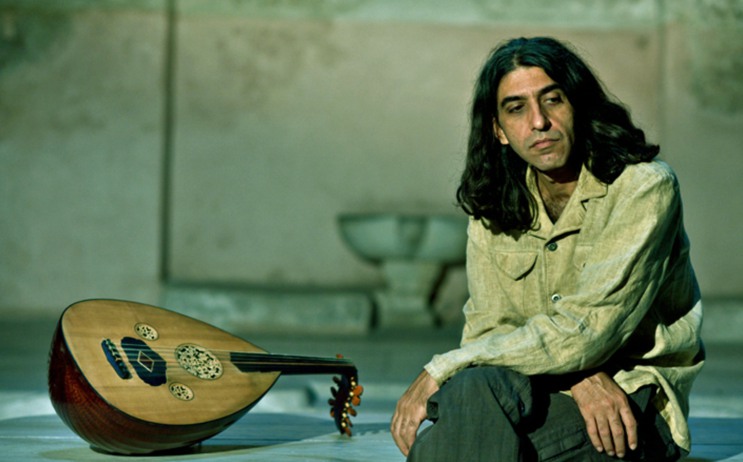
Ziad Rajab — oud, voice
Ziad Rajab was born in Aleppo, Syria, to a Syrian mother and a Palestinian father. Both his mother and grandmother played the oud, and it was from them that he received his first lessons. He later studied under Bahjat Durmosh and the eminent Arab music theorist (maqam) Rashid al-Sufi. He made his professional debut in 1983 with Sabab al-Arube. Since 1988 he has made his home in Thessaloniki, Greece. He has collaborated with numerous musicians, including Ross Daly, Yorgos Dalaras, and Haig Yazdjian, and has released several albums of his own compositions, including "Mawjet Tarab" (2000). Since 1994, Ziad Rajab has also made and repaired ouds in his own workshop.
Incense

Hyssop (Hyssopus officinalis) is a small, aromatic, perennial sub-shrub in the mint family, native to Southern Europe and the Middle East. It bears narrow, dark green leaves and upright spikes of vivid blue-violet flowers.
Hyssop ranks among the oldest ritually significant plants in human history, mentioned repeatedly in the Hebrew Bible as a purification herb — used at Passover to mark doorposts with blood, in cleansing rituals, and in Psalm 51: "Purge me with hyssop, and I shall be clean." In ancient Greece it was used both for respiratory ailments and for the ritual purification of temples.
Burned as incense, hyssop releases a sharp, warm, faintly bitter-herbaceous, camphor-like scent. It is traditionally used for spiritual cleansing, and in many faith traditions is specifically associated with the removal of impurity — still used today to clear stagnant energy from a space.

Dragon's blood is a bright red resin that can come from several botanically unrelated plant genera, most famously the Socotra dragon tree (Dracaena cinnabari), with its distinctive, umbrella-shaped canopy, found only on the Yemeni island of Socotra. When the bark is wounded, a vivid red sap seeps out and hardens in the air into resin lumps.
Dragon's blood has been traded since antiquity along the incense routes and was valued by the Greeks and Romans as a varnish, medicine, and dye. In medieval European alchemy and folk magic, it was considered a powerful agent of protection and cleansing against negative influences — a use it retains to this day across various spiritual traditions worldwide.
Burned, dragon's blood releases a warm, sweet, deep, faintly spicy-woody resinous scent. It is said to amplify the effect of other incenses in blends, and is closely associated with protection, courage, and the banishing of negative energy.