
 Deutsch
Incense of Music 40
Solos and Mixtures — Second Evening
A multisensory concert – Friday, 11 October 2019, 8 pm
First set:
Valentina Bellanova: flute, recorder
Olaf Rupp: guitar
Second set:
Elena Kakaliagou: French horn
Daniel Schröteler: drums
PANDA Theater in der Kulturbrauerei, Knaackstr. 97, 10435 Berlin
The second of three evenings of the music and incense festival "Solos and Mixtures," running from 10 to 12 October at PANDA Theater in Berlin Prenzlauer Berg. Over three evenings, we will experience twelve great artists from around the world in mostly solo concerts of various nature and style — European and Arabic classical, jazz, experimental, and free improvised music. For guests who are particularly sensitive to smoke, this event is not recommended.
Artists

Valentina Bellanova — flute, recorder
Valentina Bellanova was born in Florence, where she later studied musicology and recorder. She then furthered her instrumental studies in Germany at the University of Music, Drama and Media in Hanover, where she obtained her Soloist's Diploma. She moved to Berlin at the beginning of 2014. She has been very involved with classical Turkish and Arab music for several years, also studying their respective aesthetics and theories. She plays both the Turkish and the Arabic Ney and regularly performs on these instruments in various music and theatre projects, for example as a soloist at the National Theatre Thuringia, at the NDR Radio Station in Hanover, at the Kulturforum in Frankfurt (Oder), at the Komische Oper Berlin, at HAU Theater Berlin, with the Staatsorchester Braunschweig, and at Kampnagel Hamburg. Her teachers of Ney and modal music include Ross Daly, Dr. Claudia Ott, Ömer Erdogdular, and Kudsi Erguner, while she studied recorder and Early Music with David Bellugi, Federico Maria Sardelli, and Ulrich Thieme. In addition to working as a freelance musician, she teaches Ney at the Global Music Academy Berlin and at the BTMK (Berlin Conservatoire of Turkish Music), and recorder at SOS Berlin. She is also involved in research and publishing, having issued the first edition of Concertos for Recorder by Neapolitan composer Nicola Fiorenza, published by Girolamo.

Olaf Rupp — guitar
Olaf Rupp (*1963) plays improvised music on the acoustic and electric guitar. The organic flow of his music is guided neither by chance nor by dominant, willful decisions. To him, the same level of focus and attentive energy should be present in loud and fast music as well as in softer, more subdued kinds of playing. Throughout his music, he explores how motion-clusters can be perceived as one agglomerated sound in motion. Besides many collaborations, five solo albums have been published so far on the labels FMP, RELATIVE PITCH, GROB, and GLIGG. Olaf Rupp has toured in many countries and performed with extraordinary musicians such as Paul Lovens, Tristan Honsinger, Peter Brötzmann, Butch Morris, Lol Coxhill, John Zorn, and Tony Buck. He is an outstanding solo performer on both electric and acoustic guitar. Important groups include XENOFOX, his duo with Rudi Fischerlehner, a duo with cellist Ulrike Brand, and WEIRD WEAPONS with Tony Buck and Joe Williamson.
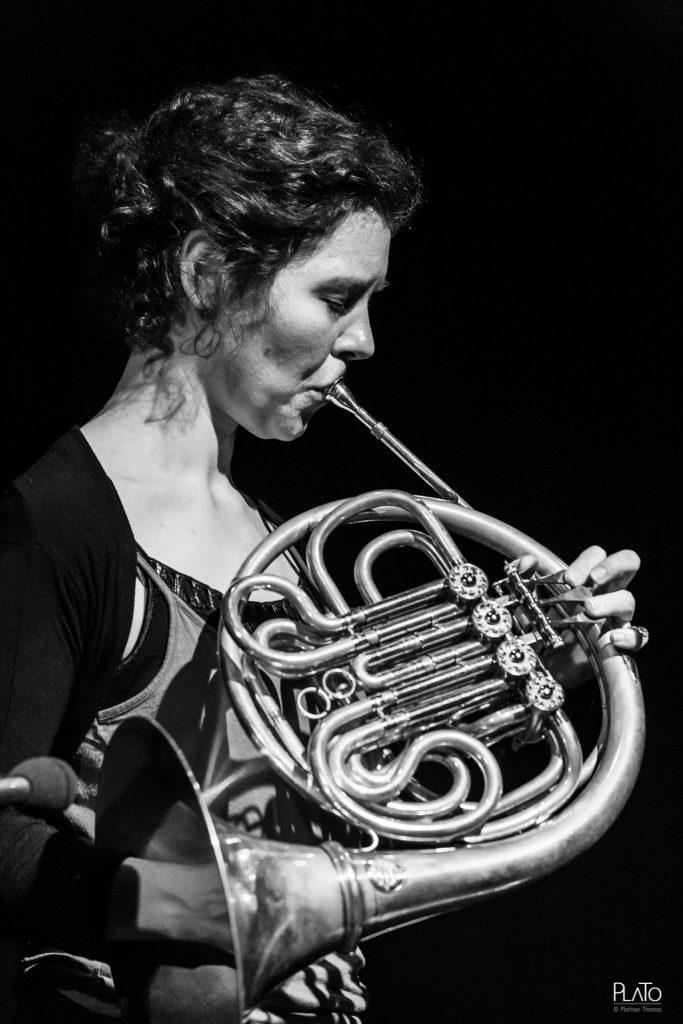
Elena Kakaliagou — French horn
Elena Kakaliagou is a Greek-Austrian French horn player based in Berlin. Her work is deeply rooted in contemporary classical music, experimental sound, and free improvisation. Kakaliagou is renowned for her exploration of extended techniques on the horn, pushing the instrument's conventional boundaries to create a vast palette of sounds, from delicate whispers and multiphonics to raw, textural noises. She is a core member of several prominent ensembles, including the brass trio Zinc & Copper and the renowned new music ensemble zeitkratzer.

Daniel Schröteler — drums
Daniel Schröteler (born 17 August 1974 in Düren) is a German jazz drummer. Given his first drum kit at the age of five, he studied jazz at the Hogeschool voor de Kunsten (ArtEZ) in Arnhem from 1990 to 1997. From 2000 he taught drums and rhythm at Johannes Gutenberg University Mainz, also teaching in Arnhem from 2002 to 2003. Since 2003 he has worked as a freelance musician. Schröteler is a member of various bands, including the Christian Weidner Trio, the Henning Berg Quartet, the Werner Neumann Quartet, the Matthias Haus Ensembles, and the groups Supdiver, TITZ, and Talking Jazz. He has also worked in a duo with Antonis Anissegos, with Hayden Chisholm's The Inflictor, and with Marla Glen. With Philipp Gropper, Philip Zoubek, and Petter Eldh he formed the band Tau. Since 2016 he has been part of Tobias Christl's Wilderer.
Incense
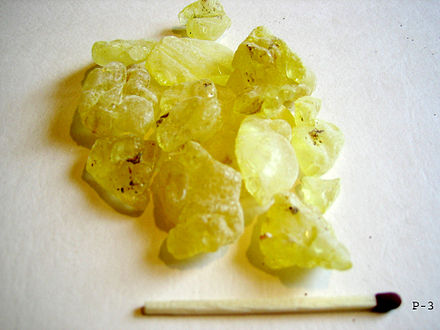
Mastic, also known as mastiha, is a resin from the mastic tree (Pistacia lentiscus), an evergreen shrub found across the Mediterranean, though the resin from the Greek island of Chios is especially renowned. Incisions in the bark release a clear sap that hardens in the air into brittle, pale yellow tears.
On Chios, mastic has been harvested since antiquity and was known in ancient Greece and Rome as a chewing gum and flavoring agent. Traditional Chios mastic harvesting today holds protected designation of origin status within the EU. Over the centuries, the resin also found wide use in traditional medicine, including for digestive support.
As incense, mastic gives off a sweet, woody fragrance with subtle hints of pine and citrus — often described as refreshing and uplifting. It is traditionally used in religious ceremonies, meditation, and aromatherapy, believed to promote relaxation, reduce stress, and enhance focus.

Thyme (Thymus vulgaris) is a low-growing, evergreen sub-shrub native to the Mediterranean, with tiny, strongly aromatic leaves and small violet-pink flowers. A member of the mint family, it rarely grows more than a few centimetres tall.
In ancient Egypt, thyme was used in embalming; in ancient Greece it was burned as incense in temples — the Greek word "thymos" is linked to courage and vital spirit, and Greek soldiers are said to have rubbed themselves with thyme oil before battle to gain bravery. In medieval Europe, sprigs of thyme were placed under pillows to ward off nightmares and grant courage, and for centuries it remained a staple of folk medicine as an antiseptic remedy for respiratory complaints.
Burned as incense, thyme releases a warm, herbaceous, faintly medicinal-green scent with a peppery sharpness. It is associated with courage, cleansing, and protection, traditionally used to clear a space of illness and negative energy.