
 Deutsch
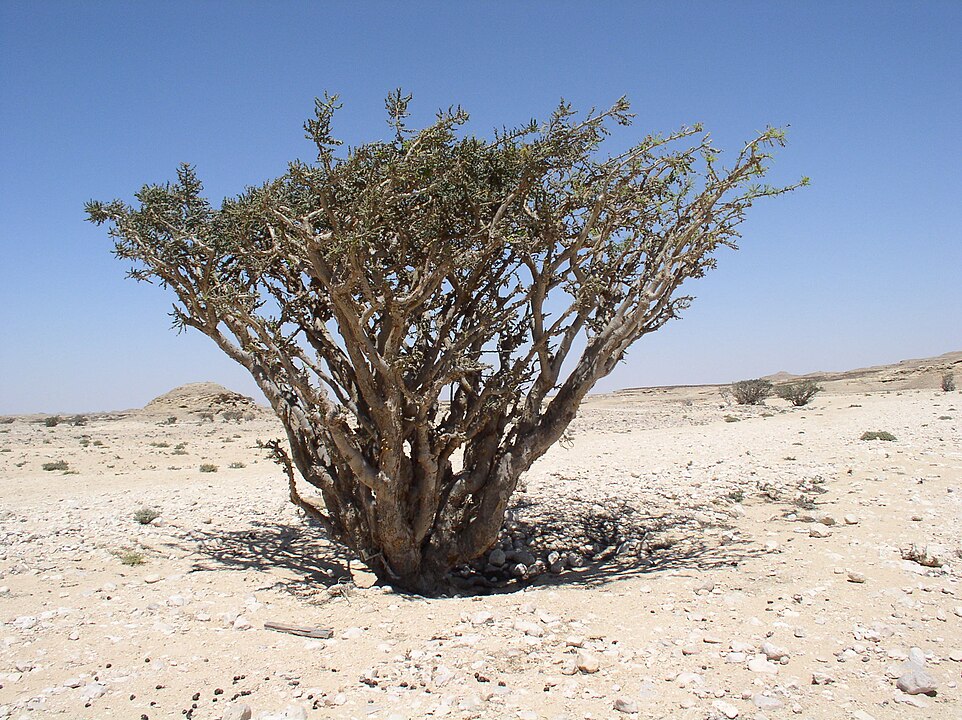
The first time you place a piece of frankincense on the embers, you are rarely thinking that you are smelling thousands of years of trade history. Even more rarely do you think that “frankincense” as a single thing does not exist. The word covers the resin of several species of the genus Boswellia: a good two dozen have been botanically described, but only a handful shape the market. Depending on species, location, harvest time and sorting, the resin smells and smokes completely differently: fresh and lemony, sweet and balsamic, peppery, dark and resinous, or almost like a conifer forest. This text walks through the most important origins, from Dhofar in Oman via Yemen to Somalia, Ethiopia and India.
A tree that wants nothing but stone
Frankincense trees are frugal. They grow on barren, rocky ground in the dry regions of southern Arabia, the Horn of Africa and India, often with several twisted trunks and a flat crown. The resin forms as a wound seal: harvesters score the bark with a special knife, the milky sap emerges and hardens over several weeks into the “tears” that are later sorted by hand. The first cuts of a season usually yield the lesser material, later harvests the better grades. This is exactly why colour, size and scent depend so strongly on the time of harvest.
This frugality is also the problem. The International Union for Conservation of Nature (IUCN) classes Boswellia sacra, one of the most important species, as “near threatened”; overgrazing, fire and over-tapping put pressure on the stands. Anyone who buys frankincense is therefore always buying a piece of an increasingly scarce landscape.
On top of that, the tree reacts slowly to interference. If it is tapped too often and too deeply, the plant is weakened and produces fewer viable seeds. Young trees barely regenerate on grazed land, because goats and camels eat the shoots. The best tears therefore often come from stands that are managed gently and with breaks.
A short history of the scent
Frankincense is one of the oldest trade goods in the world. Around 1470 BCE, the Egyptian queen Hatshepsut equipped an expedition to the Land of Punt, which she knew as the source of frankincense and myrrh; the reliefs in her mortuary temple at Deir el-Bahari show living trees in pots being shipped to Egypt. Whether these were actually Boswellia or related myrrh trees is still disputed among specialists. Later, the Incense Route connected the coasts of southern Arabia with the Mediterranean. Its traces in the south of Oman, including Wadi Dawkah, Shisr, Khor Rori and Al-Baleed, have been part of the UNESCO World Heritage as the “Land of Frankincense” since the year 2000.

Oman: Hojari, the benchmark
In the south of Oman, in the province of Dhofar, grows Boswellia sacra, the species many consider the “classic” frankincense. This is where the grades that serve as the benchmark are produced, and this is where you meet the term Hojari. In Oman it denotes less a single origin than a range of high-quality grades; in international trade, Hojari and “Silver” are regarded as the highest quality classes.
The most famous representative is green Hojari, also called “Royal Green” or, in Arabic, akhdar. Its tears are translucent, with a pale green to silvery sheen, and even cold they smell intensely of fresh lemon and lime. When heated, a delicate sweetness, a hint of orange peel and a bright, almost coniferous undertone come in. The smoke is white, soft and barely bitter. The result feels “clean”, clear and airy. It is no coincidence that this Hojari is also prized as chewing gum, because the taste is round and not very bitter.
Below it follow further grades: a yellowish-white “Superior” Hojari, which smells somewhat warmer and softer, and an amber-brown Hojari, which is stronger, more resinous and less citrus-driven. In trade you also come across names such as Najdi, Shazri and Sha’abi. They stand for other growing sites and quality levels and are generally darker, cloudier and more resinous, with less citrus and more wood, smoke and bitterness. That does not make them worse, only different: they are traditionally valued for everyday use in Omani households, and many swear by their stronger, warmer character. However, descriptions vary from dealer to dealer, and the names are not protected; anyone who wants to be sure should ask about origin, harvest year and sorting.

Comparing Hojari for the first time, you quickly notice how closely the senses follow the price difference. A good piece of green Hojari smells of a freshly cut citrus fruit even in the hand, without any warmth. Darker grades such as Sha’abi, by contrast, are often described as warmer and smokier and need some heat to open up. Both impressions belong to the diversity of the region, and both have their place, in everyday household use as much as at celebrations and religious occasions.
Yemen and Socotra: the quiet relatives
Boswellia sacra also grows in the east of Yemen, in Hadramawt and Mahra. Botanically and in scent, this frankincense is very close to the Omani one, and for centuries southern Arabia as a whole, not just present-day Oman, was the heart of the trade. Today, Yemeni frankincense is hard to find on international markets, and indications of origin are often vague; war and instability make harvest and export difficult.
The island of Socotra plays a special role. It is home to several endemic frankincense trees, including Boswellia socotrana and Boswellia popoviana, which grow nowhere else. Their resins are hardly traded and are of botanical and local interest rather than a product you could buy in Europe.
Somalia, part one: Maydi, the king
On the Horn of Africa grows a species that differs clearly from the Arabian ones: Boswellia frereana, which occurs only in the north of Somalia, in Somaliland and Puntland, where it clings to cliff faces and limestone slopes. Its resin is called Maydi (also Yigaar or “Coptic frankincense”), and locals call it the king of frankincenses. The tears are large, clear and golden yellow. The scent is lemony, peppery and sweet at the same time and recalls elemi. Maydi burns with strikingly little smoke and very cleanly, which is why it is popular in Arabia as chewing gum. It is also processed there into a paste applied for joint complaints.
According to reports, most of the harvest goes to Saudi Arabia, where pilgrims take the resin home. There are up to seven trade grades. And although Maydi is considered the king, on the Omani market the very best Hojari is said to be even more expensive. Both hold their rank, just in completely different ways: Maydi is clear, sweet and peppery, Hojari fresh, lemony and airy.
A special feature of Maydi is that it serves not only as incense. In Somalia and on the Arabian Peninsula it is chewed and used in folk medicine. That a resin moves so naturally between kitchen, medicine and ritual says a lot about the role of frankincense in these cultures: it is less a luxury good than everyday life.
Somalia, part two: Beyo and Boswellia carterii
Somalia’s second great frankincense is called Beyo and is usually traded under the name Boswellia carterii. Whether this is a species of its own or a form of Boswellia sacra is botanically disputed: an influential study from the 1980s held both to be the same species, while more recent chemical analyses point rather to different chemotypes. To the nose, however, the difference is clear. Somali Beyo is darker and more resinous than Hojari, with more wood and smoke and less citrus. It delivers the volume: Somalia is considered one of the largest frankincense suppliers in the world, and a large share of trade frankincense and essential oil comes from this source. For Beyo there are usually three trade grades.
For scent perception this is a useful thought: the African grades are not simply “cheaper” variants of the Arabian ones, but aromas of their own with their own uses. Anyone who knows only a single frankincense knows only a fraction of the possibilities.
Ethiopia, Eritrea, Sudan: the paper tree
Further west and south, further species grow. Boswellia papyrifera, the “paper tree” with its peeling bark, is widespread in Ethiopia, Eritrea and Sudan and is therefore also traded as Sudanese frankincense. Its tears are large and light, and the scent is often described as fresher, sharper and less sweet than that of the Arabian grades; typical are esters such as octyl acetate, which give it something fruity and cool. In addition there are Boswellia rivae and Boswellia neglecta, which are used in Ethiopia, Somalia and Kenya. Their resins are regarded as distinct but are little standardised and reach Europe less often. At Incense of Music, Boswellia rivae appeared in the fifth concert as one of these rarer species.
India: Salai Guggul
A frankincense tree also grows on the Indian subcontinent: Boswellia serrata, known in Sanskrit and Hindi as Salai Guggul. Its resin smells lemony and fresh, but more austere and less sweet than the Arabian grades. In the Ayurvedic tradition it has long been important, and in the making of Asian incense it is the frankincense par excellence. The term “olibanum” is mostly used in trade for frankincense in general; some specialists, however, want to define it more narrowly and restrict it to the Indian resin.

What you smell: a little chemistry
A frankincense tear consists of resin, gum and essential oil. The scent comes from the volatile fractions, above all terpenes such as α-pinene and limonene, whose proportions change from species to species and from site to site. The famous boswellic acids and substances such as incensole acetate, by contrast, are hardly volatile; they shape chemistry and research more than smell.
How you heat the resin matters, too. On glowing charcoal it burns hot, and the scent becomes smokier, more bitter, darker. On a mica plate or an electric incense warmer that heats only gently, the volatile, lemony fractions show themselves much longer. Anyone who really wants to get to know green Hojari should try it this way.
A simple test at home: place two different grades side by side, each on its own warmer or mica plate, and wait five minutes. The first cloud of scent is usually the most lemony and volatile; only later do the resinous and woody tones emerge. This way you get to know frankincense in phases, like a perfume with top, heart and base notes.
What to look for when buying
Good dealers state species, origin and harvest year. Look for whole tears rather than dust and broken pieces, for translucency and even colour, and for the smell when cold: it should be clear, not musty, not soapy, not artificial. A very low price for “Hojari” is a warning sign, because the term is not protected. And finally, sustainability is worth a look: fair trade relationships and certifications such as FairWild are one way of protecting the stands that make this scent possible in the first place.
Frankincense at Incense of Music
In our concerts, too, frankincense is a recurring guest: it has been used in numerous concerts, for example in concerts 8, 18 and 25, each time combined with other plants and resins, and it is part of tonight’s concert as well, on 16 October 2026. The appeal often lies precisely in the interplay: a clear, lemony frankincense surrounds a bright sound differently than a dark, resinous one surrounds a deep one. If you consciously notice the scent at the next concert, you may hear the music a little differently.
You will find more about the plant and the concerts in which it appeared on our page Frankincense.