Deutsch
Nordmann Fir (Abies nordmanniana)
The Nordmann fir (Abies nordmanniana) is a majestic, straight-trunked, evergreen conifer in the pine family, capable of reaching heights of 40 to 60 metres and ages of up to 500 years. It is native to the western Caucasus and the Eastern Pontic Mountains — in Georgia, Russia, northeastern Turkey, and Azerbaijan — and was named in 1842 after the Finnish biologist Alexander von Nordmann, who discovered it in the Caucasus in 1835. Within its natural range it is now considered vulnerable, owing to overharvesting for timber and habitat loss.
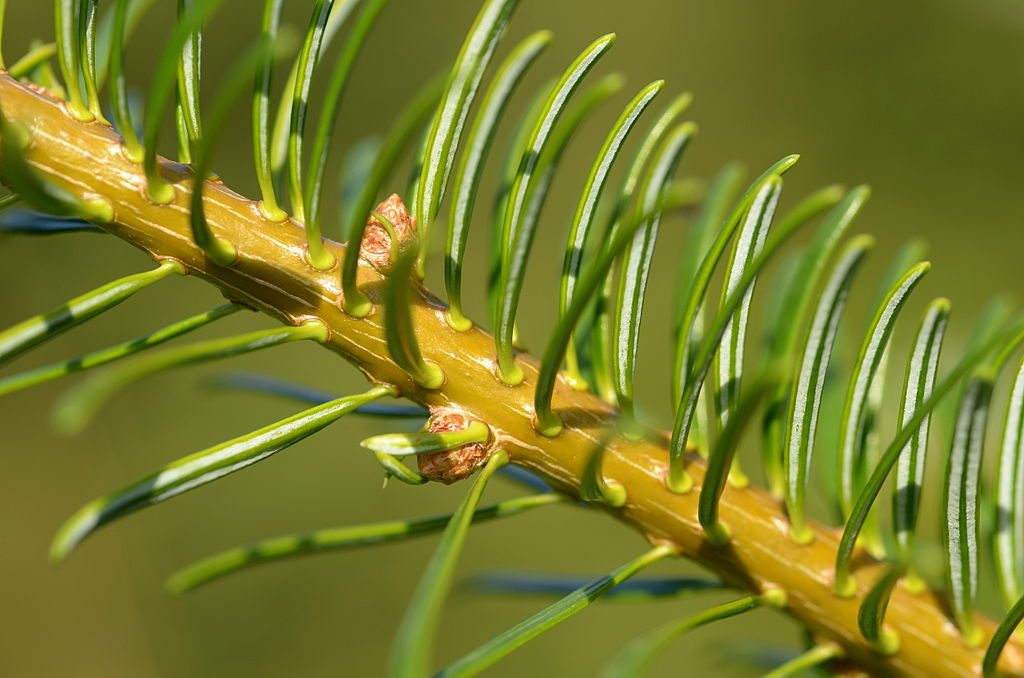
The species reached Europe in the 19th century first through botanical gardens, before its 20th-century rise as the continent's dominant Christmas tree. Today the Nordmann fir is the most widely used Christmas tree species worldwide — largely because its soft, dark green needles stay on the branch for weeks after cutting, unlike the Norway spruce it displaced as the traditional favourite. The leading producer is Denmark, with a stock of around 100 million trees, roughly 5 million of which are exported each year, many bound for the Christmas markets of central and western Europe. As a symbol of the festive season, and just as readily cast aside on the street once it ends, the fir embodies both sides of winter celebration — its warmth and its wastefulness. Its flat needles, silvery on the underside, are also pleasantly soft and barely prickly, which makes it especially popular for indoor use compared with spinier conifers. The Nordmann fir only became Western Europe's dominant Christmas tree species toward the end of the 20th century; before that, since Prince Albert popularized the Christmas tree custom in Britain in the 1840s, the Norway spruce had usually filled that role. Besides Denmark, Germany, the Netherlands, and the United Kingdom also rank among significant growing countries; in its native range, the species is sometimes also called the Caucasian fir.
Burned as incense, fir resin releases a fresh, resinous, green, needle-like scent. It is associated with renewal, the turning of the year, and the immediate presence of the forest, evoking a clear, wintry woodland atmosphere. Even after cutting, its characteristic fir scent lingers in a room for weeks, which is why Nordmann fir branches and wreaths are traditionally used throughout the entire Advent season each year.
Used in the following concerts