
 Deutsch
Incense of Music 25
Trommel und Wind
A multisensory concert – Saturday, 21 April 2018, 7 pm
Valentina Bellanova: ney, recorders
Sebastian Flaig: percussion
Incense: Frankincense, Labdanum
Salon Dreiklang, Paul-Robeson-Strasse 47, 10439 Berlin
Incense of Music 25 celebrates a quarter century of concerts, presenting for the occasion sounds, scents, and suggestions from the millennia-old relationship and tension between Orient and Occident. The duo "Trommel und Wind" ("Drum and Wind," Valentina Bellanova and Sebastian Flaig) undertakes a journey connecting medieval and contemporary, north and south, Arabic, Turkish, Italian, Greek, and German traditions. Frankincense and labdanum will be burned for the occasion — storied treasures of humanity's olfactory imagination.
For guests who are particularly sensitive to smoke, this event is not recommended.
Artists

Valentina Bellanova — ney, recorders
Valentina Bellanova was born in Florence, where she studied musicology and humanities at the University of Florence, as well as recorder at the Florence Conservatory. She came to Germany for further studies in Artistic Training and the Soloist Class at the University of Music, Drama and Media in Hanover, moving permanently to Berlin in early 2014. For several years, Valentina has been deeply involved with classical Turkish and Arab music. She plays both Turkish and Arabic ney as well as zurna, a Turkish folk instrument. She studied ney and modal music with teachers including Ross Daly, Ömer Erdogdular, and Kudsi Erguner, and recorder and early music with David Bellugi and Federico Maria Sardelli in Italy and Prof. Dr. Ulrich Thieme at the HMTM Hanover. With ney and zurna, she performs regularly in theatre productions, including as a soloist at the Landestheater Thüringen, at NDR Hanover, at the Kulturforum Frankfurt (Oder), at the Komische Oper Berlin, at HAU Theater Berlin, and at Staatstheater Braunschweig. She also performs regularly with several music projects: Berlin Oriental Group, Babylon Orchestra, Nawa Ensemble Berlin, Concerto Foscari (an international early music ensemble), Wedding Orchestra for Middle East Music, and the duo Winds and Percussion with Sebastian Flaig. She is also active in editorial work, having published the first edition of the recorder concertos by Neapolitan composer Nicola Fiorenza (published by Girolamo). Beyond her work as a freelance musician, she has taught recorder at German music schools for over ten years, with students ranging from age four to eighteen as well as adults.

Sebastian Flaig — percussion
Sebastian Flaig, from Freiburg, studied ethnic percussion and jazz drum set at the Hochschule für Musik Leipzig under Alexander Bauer, Axel Schüler, and Heinrich Köbberling. To deepen his knowledge of oriental percussion, he lived for a year in Istanbul, studying with various masters, including darbuka virtuoso Misirli Ahmet. He learned Persian percussion with Behnam Samani. His stylistic range spans oriental music, jazz, and contemporary music through to early music, performing in ensembles including the Taner Akyol Trio, with Maya Youssef, Pain Perdu, the KalhorFlaig Duo, Susan Weinert, Ensemble Adapter, the Lautten Compagney Berlin, and the Musikwerkstatt Köln. Sebastian has performed as a soloist with the Staatsorchester Braunschweig, the Hamburg Symphony, and the Mittelsächsische Philharmonie, as well as in various dance and theatre productions, including at the Komische Oper, the Stadttheater Freiburg, and the Bauhaus Dessau. In 2018 he won the German Record Critics' Award for ethnic music with Maya Youssef for "Syrian Dreams." He has composed music for documentary films and theatre productions, and has toured Lebanon, Syria, Turkey, Bulgaria, and South America, among other regions.
Incense

Frankincense comes from small, deciduous trees of the genus Boswellia, growing in the arid regions of Somalia, Yemen, Oman, and other parts of the Horn of Africa, as well as the Arabian Peninsula and India. Incisions in the bark release a milky sap that hardens in the air into aromatic, tear-shaped resin lumps, known as "frankincense tears." The ancient Egyptians called these resin pearls the "sweat of the gods." More than 82% of the world's frankincense production still comes from Somalia today.
Frankincense ranks among the oldest and most precious incense materials in human history, traded for over 5,000 years along the legendary Incense Route connecting Arabia to the Mediterranean. It played a central role in the religious rites of ancient Egypt and Mesopotamia, as well as in Judaism, Christianity, and Islam — appearing in the New Testament as one of the three gifts brought to the infant Jesus. For centuries it was so highly prized that its value matched that of gold.
Burned as incense, frankincense releases a warm, resinous scent with subtle notes of citrus and pine. It is regarded by many as the archetypal incense material, still associated today with purification, prayer, and the creation of sacred space across numerous religious traditions worldwide.

Boswellia sacra in Dhofar

Trade routes through Nabataean territory

Hieronymus Bosch – "The Garden of Earthly Delights" (detail)

Fra Bartolomeo – "The Incarnation with Six Saints" (1515)

Labdanum is a resin obtained across the Mediterranean from various species of rockrose (Cistus), an independent plant family unrelated to true roses. In summer, an oily resin exudes from the leaves and twigs under the heat of the sun, as though the plant were sweating. Today, most labdanum comes from the gum rockrose (Cistus ladanifer), which produces significantly more resin than other species. In antiquity, the resin of the Cretan rockrose (Cistus creticus) was chiefly used; the Greek scholar Dioscorides described how shepherds drove their goats through dense rockrose thickets, later combing the sticky resin lumps out of the animals' fur and beards — a harvesting method still practiced in Crete into modern times, using leather straps in place of ropes.
The name labdanum derives from the Syro-Phoenician word "ladan," meaning "sticky herb." Already in ancient Egypt its sweet, animalic scent was highly prized, forming part of the famous incense blend "Kyphi." For centuries it also served as a remedy and was considered one of antiquity's most coveted aphrodisiacs.
Burned as incense, labdanum releases a warm, sweet, leathery, animalic scent with a subtle, honey-like depth. In perfumery it remains widely used as a substitute for ambergris, though burned as incense it develops an entirely distinctive character of its own.

Bordado de Castelo Branco
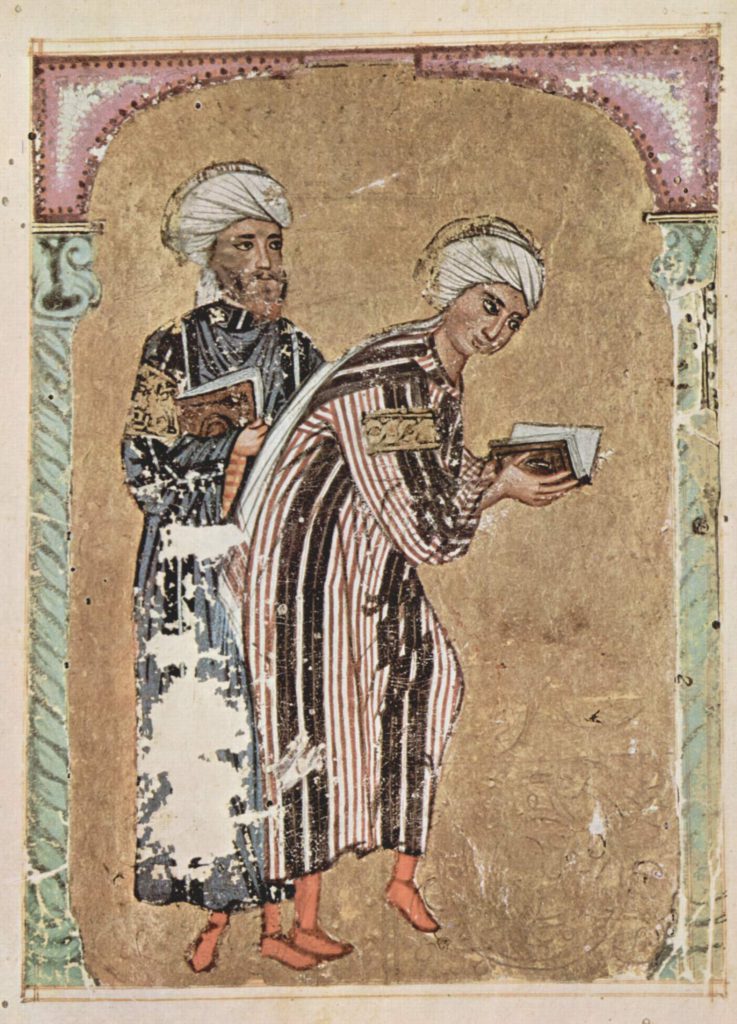
Herbal of Dioscorides, Syrian painter