Deutsch
Elemi (Canarium luzonicum)
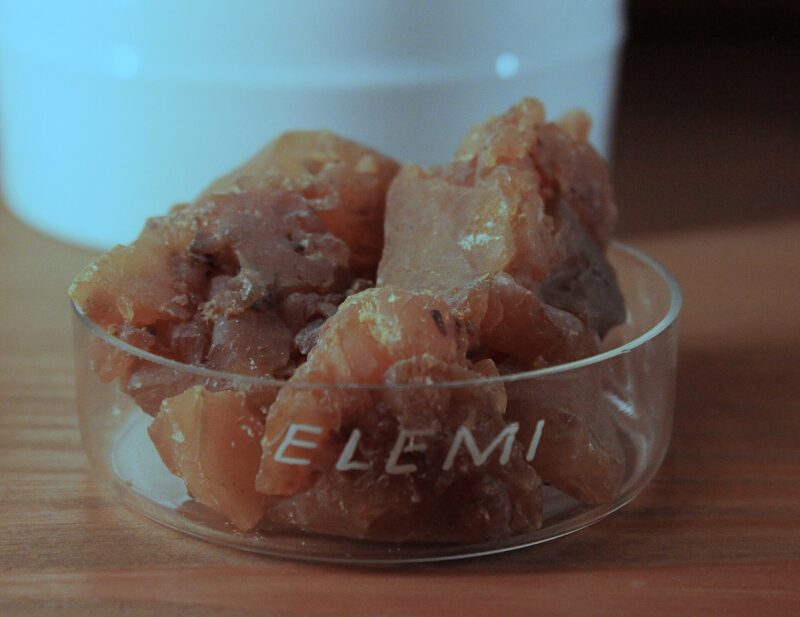
Elemi is the resin of Canarium luzonicum, a tropical evergreen tree in the family Burseraceae — the same family that produces frankincense and myrrh. The genus Canarium comprises around 100 tropical and subtropical tree species, distributed from West Africa across South and Southeast Asia, particularly the Philippines, to the Pacific islands; the trees reach heights of 40 to 50 metres. Incisions in the bark release a soft, pale yellow, honey-like resin that gradually hardens in the air, from which the essential elemi oil is steam-distilled. Botanically closely related to the true frankincense and myrrh trees, elemi shares their resinous-balsamic base character, though it appears noticeably brighter and more citrus-like. The best harvest period falls in the warmer months, when resin flow is strongest; the Philippines is by far the most important source today, where local harvester families often work the trees across generations, carrying the freshly gathered resin in baskets to trading posts.
The name elemi is thought to derive from an Arabic phrase meaning "as above, so below" — a nod to the hermetic principle, said to reflect the resin's sublime effect on mood and spirit. Elemi has long been used in traditional medicine across Southeast Asia and in ancient Egypt, including in embalming — much like myrrh and frankincense, it served as an ingredient in ointments and embalming practices. In European pharmacy it was for centuries a valued ingredient in wound-healing balms, and remains used in herbal medicine today for bronchitis, catarrh, and persistent coughing, as well as skincare. Commercially, the resin is also used in varnishes, lacquers, and certain printing inks. In Catholic church tradition, elemi was occasionally used as a more affordable substitute for frankincense in incense blends, particularly in regions where true frankincense was hard to obtain.
Burned as incense, elemi releases a fresh, sharp, citrusy-resinous scent with hints of pine needles and a faintly spicy undertone — brighter and more lemon-like than classic frankincense. Its soft, sticky texture makes it especially well suited to incense making, where its aroma is often described as both uplifting and calming. It is associated with mental clarity, an invigorating effect, and a soothing, spiritual atmosphere — ideal for rituals or meditation. It is often paired with heavier resins such as frankincense or myrrh, offsetting their depth with a zesty, citrus-like brightness, and is regarded by some as an ideal entry point into the world of resin incense.
Used in the following concerts