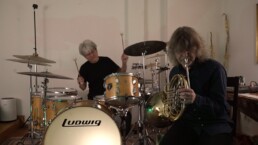
Incense of Music Nr. 52 - Shilkloper, Minami
Incense of Music 52
A multisensory concert (stream) – Saturday, 27 November 2021, 6 pm
Arkady Shilkloper: French horn, didgeridoo
Kenji Minami: drums
Incense: White Sage
Private location, Lychener Strasse, Berlin
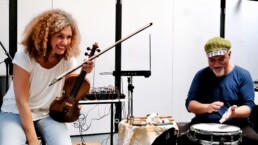
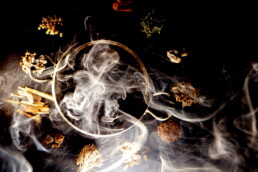
Due to the corona problematic, Incense of Music is proposing in this difficult time concerts of a rather private nature via stream. Kenji Minami, drummer from Japan, met the Russian horn virtuoso Arkady Shilkloper for an improvised jam session. We prepared the room with white sage.

Artists
Arkady Shilkloper — French horn, didgeridoo
Arkady Shilkloper (born 17 October 1956) is a Russian multi-instrumentalist — horn, alphorn, flugelhorn — and composer now based in Germany. Born in Moscow, he began playing alto horn at the age of six. After two years of military service, he studied at the Moscow Gnessin Institute from 1976 to 1981, joining the orchestra of the Bolshoi Theatre at the same time. Since 1988 he has collaborated with pianist Mikhail Alperin, and since 1990, together with Sergey Starostin, as the Moscow Art Trio. He has performed with Lionel Hampton, Lew Soloff, and the Vienna Art Orchestra, among others, and released five solo albums. Since 1994 he has been a member of the ensemble "Pago Libre." Shilkloper is widely regarded as one of the musicians who helped shape extended playing techniques for both French horn and alphorn.
Kenji Minami — drums
Kenji Minami is a Berlin-based Japanese drummer who redefines the boundaries of musical expression as an experimental improvisation musician. His drumming avoids regular rhythm and fixed patterns, instead combining vibrations meant to resonate with the mind and body of the listener — an approach he describes as "Zen drumming." Minami has performed at venues including artloft.berlin, where he gave a musical performance as part of an exhibition opening in 2019. His practice explores the relationship between sound and silence, and awareness of the present moment.
Incense

White Sage
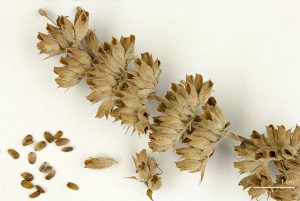
White sage is an evergreen perennial shrub native to the southwestern United States and northwestern Mexico, particularly the coastal sage scrub habitats of Southern California and Baja California. It typically grows 1.3 to 1.5 metres tall, with whitish-green, evergreen leaves densely covered in fine hairs that hold aromatic oils — an adaptation to the aridity of its habitat.
For numerous Indigenous peoples of California, including the Chumash, Cahuilla, and Tongva, white sage has been a sacred plant for generations, used in purification ceremonies and spiritual practice. In recent decades, growing commercial demand has led to overharvesting of wild populations, prompting many Indigenous communities and conservationists to ask that only cultivated — not wild-harvested — plants be used, and that the plant be treated with respect.
The dried leaves are traditionally bundled into smudge sticks and burned, releasing a strongly aromatic, herbaceous, camphor-like scent with a faint sweetness. Its smoke is believed to have cleansing properties, clearing negative energy from a space and promoting mental clarity and relaxation.
Incense of Music 51, Rafalimanana: Debussy
Incense of Music 51
Yannick and Friends — Episode 4
A multisensory livestream concert – Saturday, 26 June 2021, 8 pm
Yannick Rafalimanana: piano
Incense: Palo Santo
Livestream concert
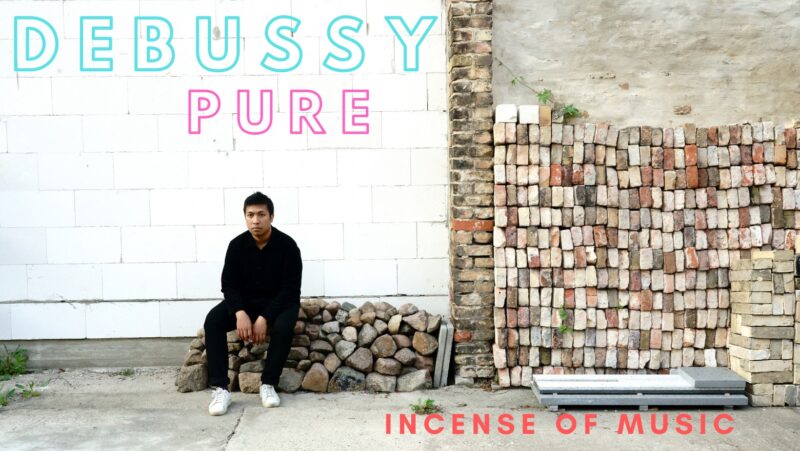
Welcome to the fourth episode of the series "Yannick and Friends." For this edition, Yannick Rafalimanana was pleased to introduce the Berlin-based project "Incense of Music" as co-host — the pair's very first digital collaboration. For this special occasion, Yannick selected piano works by Debussy, those ever-inspiring impressionist masterpieces that transport listeners to the most remote corners of the imagination. The program was performed on a historical 1896 Bechstein piano, while the room was incensed with Palo Santo by Fabio Dondero and Dominik Breider. The concert was professionally recorded to offer a full audiovisual experience at home.

Photo by Fabio Dondero
Artists
Yannick Rafalimanana — piano
French pianist Yannick Rafalimanana has developed an international concert career as a recitalist and chamber musician. Recent performances have taken him to halls all over the world, including the Berlin Philharmonie, the Elbphilharmonie Hamburg, Wigmore Hall, Konzerthaus Berlin, Köln Philharmonie, the Vienna Konzerthaus, the Shanghai Symphony Orchestra Chamber Hall, and the Kennedy Center in Washington. He has made chamber music with countless artists, including Kim Kashkashian, Steven Isserlis, Noah Bendix-Balgley, Arnold Steinhardt, and Itzhak Perlman. Born in Lille, he studied at the Conservatory of Lille and later the Paris Conservatoire, before earning his graduate diploma at the New England Conservatory in Boston under Vivian Weilerstein. He taught chamber music at the Folkwang University of Arts in Essen from 2015 to 2018. In 2022 he launched "Yannick's Salon," a concert series in his Berlin neighbourhood.
Incense

Palo Santo
Palo Santo — Spanish for "holy wood" — comes from the tree Bursera graveolens, native to the dry coastal forests of Ecuador, Peru, and neighbouring regions of South America. Its aromatic wood is traditionally never cut from a living tree, but collected only years after the tree has died naturally, once the resin has fully developed within the wood.
The Inca and other pre-Columbian cultures of South America already used Palo Santo for spiritual cleansing rituals, to ward off negative energy, and in traditional medicine. In recent years, sharply rising global demand — driven by its spread through wellness and incense practices worldwide — has raised sustainability concerns much like those surrounding white sage.
Burned, Palo Santo releases a warm, sweet, woody scent with notes of pine, mint, and citrus. It is traditionally burned as sticks or shavings, believed to dispel negative energy and promote calm, clarity, and creativity.
Incense of Music 49 - Dhalgren in Duo STREAMING
Incense of Music 49
Dhalgren in Duo — Songs from a Dystopian Utopia
A multisensory concert – Friday, 30 May 2020, 8 pm
Chris Dahlgren: vocals, guitar, viola da gamba, composition
Evi Filippou: voice, vibraphone, drums
Incense: Laurel
Streaming from PANDA Theater in der Kulturbrauerei, Knaackstr. 97, 10435 Berlin
The virus brings new challenges: no audience at the concerts, video and audio streaming instead of the live experience. But how does it work with scents and incense in the virtual world? We're finding out.
Chris Dahlgren (voice, guitar, viola da gamba, baglama) and Evi Filippou (voice, vibraphone, drums) performed songs from the new album "Songs From A Dystopian Utopia" in a live simulcast from PANDA Theater. Normally performing as a four- or five-piece band, in this reduced duo formation Dahlgren and Filippou dig into the intimate corners and landscapes of Dahlgren's songs, which are truly cross-genre and impossible to categorize.
The album is a suite about dystopias and utopias, about abysses and unexplored corners of the self — and at the same time an album about Berlin. Dahlgren was influenced by older science fiction works such as Aldous Huxley's "Brave New World" and the novels of brothers Arkady and Boris Strugatsky. Music journalist Wolf Kampmann described the album as a descent from Berlin's nocturnal surface into a darker, subterranean world full of cobwebs and hidden beauty — ultimately more utopia than dystopia.

Artists
Chris Dahlgren — vocals, guitar, viola da gamba, composition
Chris Dahlgren (b. 1961 in New York City) is an American jazz bassist and polyinstrumentalist. Dahlgren, who grew up in Denver, played the cello as a child before switching to the bass. He studied jazz at the University of Cincinnati College-Conservatory of Music until 1986 and composition and experimental music at Wesleyan University until 2003, studying with Anthony Braxton, Alvin Lucier, and Christian Wolff. He performed as a sideman with musicians such as Joe Lovano, Charles Tolliver, and Herb Ellis. In Berlin he quickly became a creative driving force in the scene, including in the bands Johnny La Marama and Lexicon, as well as alongside Gebhard Ullmann. He later moved increasingly toward songwriting, singing, and guitar, founding the band Dhalgren, named after Samuel Delany's dystopian novel of the same name. Since 2003, he has been teaching ensemble playing at the Hochschule für Musik "Hanns Eisler" in Berlin.
Evi Filippou — voice, vibraphone, drums
Evi Filippou is a vibraphonist and percussionist with experience in chamber music as well. As a member of the band Dhalgren, she contributed to their second album, "Songs From A Dystopian Utopia" (2020), released on Boomslang Records.
Incense

Laurel (Laurus Nobilis)
Bay laurel is an evergreen shrub or small tree native to the Mediterranean, capable of reaching up to ten metres in height. Its glossy, leathery dark-green leaves carry a bold, spicy aroma and contain essential oils with anti-inflammatory properties.
In ancient Greece, laurel was sacred to the god Apollo, and wreaths woven from its branches crowned the victors of athletic and poetic competitions — a tradition that still echoes today in the word "baccalaureate" (literally, "laurel berry"). In the Bible, laurel is often an emblem of prosperity and fame, and in Christian tradition it symbolizes the resurrection of Christ.
Burned as incense, laurel gives off a warm, spicy-resinous scent with a faint, sweet sharpness. The dried leaves are traditionally burned to energetically clear a space and create a focused, ceremonial atmosphere — a scent associated with clarity and a certain sense of dignity.
More Videos
Incense of Music 48 - Chisholm, Tschabaschwili
Incense of Music Nr. 48
A multisensorial concert – Thursday, 5th March 2020, 8 p.m.
Hayden Chisholm, saxophone. Meri Tschabaschwili, piano – Fabio Dondero and Dominik Breider (Incense burning): eucalyptus and lemongrass.
PANDA Theater in der Kulturbrauerei, Knaackstr. 97, 10435 Berlin

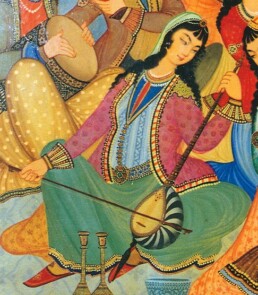
Incense of Music 47 - Joolaee, Uskov
Incense of Music 47
A multisensory concert – Saturday, 8 February 2020, 8 pm
Misagh Joolaee: kamancheh
Andrei Uskov: guitar
Incense: Cacao, Vanilla
PANDA Theater in der Kulturbrauerei, Knaackstr. 97, 10435 Berlin

We look forward to the second event of the year, a double concert by two virtuosos on very different instruments: Misagh Joolaee, kamancheh, and Andrei Uskov, guitar. A contrasting evening, harmonious in composition. It is accompanied by the warm, sweet scents of cacao and vanilla — two plants with shared roots in Mesoamerica, whose earthy sweetness lends the evening an enveloping, comforting depth.

Artists

Misagh Joolaee — kamancheh
Born in Mashhad in 1983 and raised in the northern Iranian province of Mazandaran, Misagh Joolaee began playing the violin at the age of eight. Within five years he completed learning the Persian classical repertoire "Radif." At 13 he won the Fadjr music competition in Iran, and studied setar, tar, and especially kamancheh with various Iranian masters, followed by training in piano and violin in European classical music. In 2009 he founded the ensemble "AAVAAN," performing his own compositions, and won the "Creole – Global Music" competition in Germany in 2010. In 2015 he founded the Flamenco-Persian ensemble "Chachipen" with musicians from Andalusia, Spain. In 2011 he also founded an Anatolian-Persian duo with Turkish baglama master Levent Özdemir. In 2014 he performed as kamancheh soloist in a performance of Avet Terterian's 5th Symphony with the Braunschweig State Orchestra. He worked as a lecturer at the World Music Faculty of the University of Hildesheim from 2011 to 2014, and completed his master's degree in electrical engineering at Leibniz Universität Hannover in 2015.
Andrei Uskov — guitar
Andrei Uskov is a guitarist from Belarus.
Incense

Cacao
The cacao tree (Theobroma cacao) is a small, evergreen tree native to the rainforests of the Amazon basin. Its large pods grow directly from the trunk and older branches, containing cacao beans surrounded by sweet, white pulp.
For the Maya and Aztecs, cacao was a sacred plant — its botanical name, Theobroma, means "food of the gods" in Greek. The beans were prepared into a bitter, spiced drink consumed during ritual ceremonies, weddings, and offerings; the beans themselves even served at times as a form of currency.
Burned as incense, cacao releases a warm, earthy, chocolatey aroma with a faint, slightly bitter depth. It is said to have a heart-opening, grounding effect, and remains used today in modern cacao ceremonies to support centering and emotional openness.

Vanilla
Vanilla (Vanilla planifolia) is a climbing orchid vine native to Mexico — the only orchid genus cultivated worldwide for consumption. Its long pods, the vanilla beans, form only after labor-intensive hand-pollination of the flowers, followed by a weeks-long curing and drying process.
Vanilla was first cultivated by the Totonac people of Mexico, and later adopted by the Aztecs, who used it to flavor their cacao drink. Spanish conquistadors brought vanilla to Europe, where it quickly became a prized luxury. Today, most of the world's production comes from Madagascar.
Burned, vanilla releases a sweet, warm scent with creamy undertones. It is credited with a calming, comforting effect — a scent believed to ease stress and create a cozy, inviting atmosphere.
More Videos
Incense of Music 46 - Faber, Sawada, Strasfogel, Notte / Rajab
Incense of Music 46
A multisensory concert – Friday, 24 January 2020, 8 pm
First set — String Quartet (Kaleidoskop Ensemble):
Anna Faber: violin
Mari Sawada: violin
Daniella Strasfogel: viola
Sophie Notte: cello
Second set:
Ziad Rajab: oud, voice
Incense: Cypress, Orange Blossom
PANDA Theater in der Kulturbrauerei, Knaackstr. 97, 10435 Berlin
Program, first set: Maja Ratkje – "to F" (for cello solo, 2011); Synne Skouen – "...à travers les paroles" (for violin solo, 2007); Cecilie Ore – "Lex temporis" (for string quartet, 1992); Jane Birkin – "Lost Song," after Peer Gynt Suite No. 2, op. 55, in an arrangement by Serge Gainsbourg and Grégoire Simon
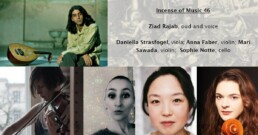
2020 has started and we are proud to announce the next event in our series. On 24 January we present a double concert in two sets: first a string quartet (Anna Faber, Mari Sawada, Daniella Strasfogel, Sophie Notte), then Ziad Rajab (oud and voice) — a program ranging from contemporary Scandinavian music to Arabic maqams. We are particularly happy to welcome four artists of the Kaleidoskop Ensemble to our series and to re-host Ziad Rajab, after our beautiful experience at concert 39 in October 2019, for another magical night. The evening is accompanied by the scents of cypress and orange blossom.
Artists

Sophie Notte — cello
Sophie Notte studied cello with Konstantin Heidrich in Berlin and Valentin Radutiu and Natalie Clein in Rostock. Previously she was a junior student with Ulrich Voss at the Saarbrücken University of Music. She received valuable chamber music impulses from members of the Artemis Quartet, Mathieu Herzog, Valentin Erben, and Konrad Elser, among others. She was a scholarship holder of the Richard Wagner Association and won 2nd prize at the Alice Samter Chamber Music Competition. She gained orchestral experience in the WDR Funkhausorchester, the Junge Deutsche Philharmonie, and as a member and principal of the Bundesjugendorchester under conductors such as Simon Rattle, Kurt Masur, and Kirill Petrenko. Sophie Notte now lives in Berlin as a freelance musician, has played several times with the soloist ensemble Kaleidoskop, and also works as a cello teacher.

Anna Faber — violin
Anna Faber, who grew up near Lake Constance, studied with Nora Chastain, Ana Chumachenco, and David Takeno, graduating with distinction in 2005. She lived in London for a longer period, working with ensembles such as the Britten Sinfonia, the Chamber Orchestra of Europe, and Ensemble Modern. In addition to her work as principal at the Basel Chamber Orchestra, she is a member of the soloist ensemble Kaleidoskop in Berlin, where she has lived for over ten years. Since then she has worked with artists including Sasha Waltz, Laurent Chetouane, and Susanne Kennedy & Georg Nussbaumer, and has performed as a musician and performer at festivals including the Sydney Festival, Wien Modern, Hitzacker, the Donaueschinger Musiktage, the Holland Festival, and the Ruhrtriennale. When she's not playing violin, she sings, dances, and occasionally unpacks the old accordion.

Mari Sawada — violin
Mari Sawada was born and grew up in Essen. At the age of four she started playing the violin with her mother; later Prof. Keiko Wataya became her teacher and an important mentor. Her path took her from Utrecht via Aachen to Berlin, where she has lived since. Since 2007 she has played primarily with the soloist ensemble Kaleidoskop in Berlin, with whom she feels deeply connected. Other formative figures in her musical life include Charles André Linale, Michael Vaiman, Joyce Tan, and especially her family.

Daniella Strasfogel — viola
Daniella Strasfogel is a violinist, violin teacher, and performer based in Berlin. She is a founding member of the soloist ensemble Kaleidoskop in Berlin. In 2018 she initiated the audience talk series "The Artist Talk!" as part of Kaleidoskop's activities, striving for exchange between artists and audience. That same year she also founded LOUDsoft, born from the impulse to create multidimensional music experiences for and with families.
Ziad Rajab — oud, voice
Ziad Rajab was born in Aleppo, Syria, to a Syrian mother and a Palestinian father. Both his mother and grandmother played the oud, and it was from them that he received his first lessons. He later studied under Bahjat Durmosh and the eminent Arab music theorist (maqam) Rashid al-Sufi. He made his professional debut in 1983 with Sabab al-Arube, a group affiliated with the Aleppo Fine Arts Association. Since 1988 he has made his home in Thessaloniki, Greece, pursuing his own musical path and performing at WOMAD (2002), the Samothraki World Music Festival (2005), and the Thessaloniki State Conservatory, among others. He has performed internationally at the Helsinki Festival (1993), the Moers Festival in Germany (2015), and further international stages. He has collaborated with numerous musicians, including Ross Daly, Yorgos Dalaras, and Haig Yazdjian, and has released several albums of his own compositions, including "Mawjet Tarab" (2000). Since 1994, Ziad Rajab has also made and repaired ouds in his own workshop, and offers oud lessons for beginners and advanced players alike.

Pieter Bruegel the Elder – "The Alchemist" (1558), engraving by Philipp Galle
Incense

Cypress
Cypress refers to several conifer species in the Cupressaceae family, most famously the slender, columnar Mediterranean cypress. It grows in rocky, well-drained soils across temperate regions and is a defining presence in the landscapes of Southern Europe, the Middle East, and North Africa. Its durable, rot-resistant wood has historically made it a prized building material for ships, furniture, and sacred architecture.
Because of its longevity — some trees live over a thousand years — and its evergreen nature, cypress has been a symbol of immortality and mourning since antiquity. It still shapes cemeteries and sacred sites across the Mediterranean and the Islamic world today, where its quiet, upright form has for centuries stood as an image of remembrance and passage between worlds.
Burned as incense, cypress releases a fresh, resinous-woody scent reminiscent of a coniferous forest after rain — clear, grounding, and never heavy. Its smoke is traditionally used to cleanse spaces, support meditation, and mark ceremonies of remembrance, offering a quiet sense of solace and stillness.

Orange Blossom
Orange blossom comes from the flowers of the orange tree (Citrus sinensis or Citrus aurantium) — small, waxy white flowers with an intensely sweet fragrance, blooming in spring on evergreen trees native to Asia that have spread across the Mediterranean over centuries.
Across many Mediterranean and Middle Eastern cultures, orange blossom water has long been a staple of the kitchen, from Middle Eastern pastries to French and Spanish desserts. In Mediterranean wedding tradition, orange blossom was also long seen as a symbol of purity and fertility, adorning bridal bouquets. Distilled, it yields the precious neroli oil, named after an Italian princess of Nerola, prized in perfumery since the 17th century.
Burned, orange blossom releases a delicate, sweet-floral scent with a faint citrus freshness. It is said to have a both invigorating and calming effect, associated with feelings of joy, purity, and new beginnings.
Incense of Music 45 - card castle trio
Incense of Music 45
Card Castle Trio
A multisensory concert – Thursday, 12 December 2019, 8 pm
Antonis Anissegos: piano
Mike Majkowski: bass
Christian Marien: drums
Incense: Grapefruit, Rosemary
PANDA Theater in der Kulturbrauerei, Knaackstr. 97, 10435 Berlin
We are pleased to present on December 12th a very special concert with experimental music: Card Castle is a piano trio, starting right after the end of the Mayan calendar. The trio's name is an anagram of Kurt Vonnegut's title of the novel "Cat's Cradle" from 1963, which describes the end of our civilization by dropping the bomb "ice-nine." The evening is accompanied by the scent of grapefruit and rosemary.
For people who are sensitive to smoke, this concert is not recommended.
Artists

Antonis Anissegos — piano
Antonis Anissegos, based since 1998 in Berlin, works as a composer, pianist (interpreter/improviser), and electronic musician (alias "unu"). His current projects include Trio IAMA, ΣΩΜΑ, and Card Castle (with Mike Majkowski and Christian Marien). He has collaborated with the Berliner Ensemble, the Neuköllner Oper, and Novoflot, and has been a frequent guest of Ensemble Adapter since 2015. Since 2006 he has performed with butoh dancer Yuko Kaseki as the duo KAYA. He began playing piano at the age of seven, studied at the State Conservatory of Thessaloniki, the Ferenc Liszt Academy in Budapest, and composition in Vienna and Cologne, before graduating from the Berlin University of the Arts (UdK). His compositions have been performed by Ensemble Modern and Ensemble Mosaik, among others, and he appears on over 60 recordings mainly in the field of contemporary creative music.

Christian Marien — drums
Christian Marien (b. 1975, Münster) is at home across a broad range of musical environments, combining melodic phrasing with an intelligent sense of abstraction, formal awareness with improvisatory instinct, as well as sound expertise with deeply rooted grooves. Preparations and objects applied to his drum set organically enhance the musical situation. Marien studied music in Amsterdam and Berlin, where he has resided since 2000. As a central figure in the Berlin jazz and improvised music scene, he co-leads collaborative projects including Superimpose, The Astronomical Unit, and I Am Three. He is also a regular member of numerous other groups such as Z-Country Paradise and the Hannes Zerbe Jazz Orchester, and frequently shares the stage with musicians such as Frank Gratkowski, Sofia Jernberg, and Gebhard Ullmann.

Mike Majkowski — bass
Born in 1983, Mike Majkowski is a double bassist from Sydney, Australia. He began his musical activities as a jazz bassist, performing with the likes of Mike Nock, Bob Mintzer, and Vince Jones. Since then, he has developed an active interest in exploratory and experimental music, and is a long-time devotee of the improvised music community in Sydney, where he frequently collaborates with Jim Denley, Jon Rose, and Chris Abrahams. He is a founding member of the Splinter Orchestra, a large-scale electro-acoustic improvisational ensemble that began in 2002. Current projects include the piano/bass/drums trio ROIL (with Chris Abrahams and James Waples) and his own work as a soloist. His debut solo album "Ink On Paper" was released by Portuguese label Creative Sources in late 2009.
Incense

Grapefruit
The grapefruit (Citrus × paradisi) is a subtropical citrus tree known for its large, sour to semi-sweet fruit. It is an evergreen hybrid with glossy, dark green leaves and
Incense of Music 44 - Voutchkova, Zerang
Incense of Music 44
A multisensory concert – Tuesday, 10 December 2019, 8 pm
Biliana Voutchkova: violin
Michael Zerang: percussion
Incense: Oakmoss, Elder
Studio Rainer Spehl, Brunnenstrasse 152, 2. Hinterhof, 10115 Berlin
After their first performance in Chicago in 2016, the duo has played at a number of occasions and recorded their first album, which will be released in 2020. Using reduced vocabulary in a highly unusual and original manner, the duo creates an intimate world of symbiotic sound.

Photo by Photomusix / C. Marx
Artists
Biliana Voutchkova — violin
Bulgarian violinist Biliana Voutchkova lives and works in Berlin as a soloist and with renowned ensembles such as Solistenensemble Kaleidoskop, the Splitter Orchestra, zeitkratzer, Ensemble Modern, and the Voutchkova/Thieke duo. She is a dynamic and thoroughly engaged performer, composer, and improviser with a truly personal musical language. Her work spans the widest possible range of music, sound, and movement, and her interests lead into various multidisciplinary collaborations. Recent projects include solo tours in Colombia, Chile, the USA, Australia, Japan, Korea, and Taiwan, curation of her own DARA String Festival, and long-durational performances at the Sammlung Hoffmann Berlin. Biliana is a recent recipient of the Composition Stipend from the Berlin Senate and grants from INM Berlin, Musikfonds, and the Trust for Mutual Understanding, New York. Music magazine FreiStil described her as "courageous, uncompromising, ultimately successful."

Photo by Photomusix / C. Marx
Michael Zerang — percussion
Michael Zerang was born in Chicago, Illinois, and is a first-generation American of Assyrian descent. He has been a professional musician, composer, and producer since 1976, focusing extensively on improvised music, free jazz, contemporary composition, puppet theater, experimental theater, and international musical forms. As a percussionist, composer, and collaborator, Zerang has over one hundred titles in his discography and has toured to 35 countries since 1981. Beginning in 2004, Zerang began working with musicians in the Middle East, traveling to perform, teach, and study in Yemen, Lebanon, Egypt, Syria, Turkey, and Morocco, among others. From 2007, he performed over 100 concerts in Poland, mostly in collaboration with Polish musicians. Michael founded the Link's Hall Performance Series in Chicago in 1985, serving as artistic director until 1989 and producing over 300 concerts. He has received three Joseph Jefferson Awards for Original Music Composition in Theater, in collaboration with Redmoon Theater. Michael has taught as a guest artist at the School of the Art Institute of Chicago and Northwestern University, and continues to hold workshops in improvisational music and percussion technique.

Vincent van Gogh – "Poplars near Nuenen"
Incense

Oakmoss
Oakmoss (Evernia prunastri) is, strictly speaking, not a plant at all but a lichen — a symbiosis of fungus and algae — growing as grey-green, branching tufts on the bark of oaks and other deciduous trees across the temperate forests of Europe.
Oakmoss ranks among the oldest and most significant materials in perfumery, already appearing in ancient Egyptian fragrance recipes. Since François Coty created his landmark scent "Chypre" in 1917, oakmoss has been the namesake heart of the entire chypre family of perfumes. Traditionally, it was harvested chiefly from the oak forests of the former Yugoslavia and France.
Burned as incense, oakmoss releases a deep, earthy, mossy-woody scent with a damp, almost leathery note — reminiscent of a forest floor after rain. It has a strongly grounding effect, associated with connection to ancient forests and deep rootedness.

Elder
The elder (Sambucus nigra) is a small, deciduous tree or shrub native across much of Europe. In early summer it bears creamy-white, flat-topped flower clusters, followed in autumn by dark purple-to-black berries.
Few plants are as deeply woven into European folklore, particularly Germanic and Nordic tradition, as the elder. It was considered a protective tree, believed to be inhabited by the "Elder Mother" — traditionally, one asked the tree's permission before pruning it, for fear of provoking her anger. Its flowers and berries have been used in folk medicine for centuries against colds, and remain valued today for supporting the immune system.
Burned as incense, elder releases a sweet, delicate, floral scent when the flowers are used, or a deeper, fruitier note from the berries or wood. In old Germanic belief, it was associated with protection, connection to ancestral spirits, and the threshold between worlds.
Incense of Music 43 - SUGAR and friends
Incense of Music 43
SUGAR and friends: Opoponax
A multisensory concert – Thursday, 28 November 2019, 8 pm
First part:
Grégoire Simon: viola, electronics
Second part — SUGAR and friends:
Isabelle Klemt: cello
David Eggert: cello
Ole Brolin: electronics
Grégoire Simon: viola, electronics
Incense: Lemon, Opoponax
PANDA Theater in der Kulturbrauerei, Knaackstr. 97, 10435 Berlin
We have the great pleasure to announce another highlight in the series Incense of Music: SUGAR and friends will contribute to a very special evening divided into two sets, between strings and electronics. Lemon and opoponax will be the scents of choice. Highest pleasure guaranteed.
Artists

Grégoire Simon — viola, electronics
Grégoire Simon works between Berlin and Paris as a performer (viola and violin), producer, and composer. After studying violin and viola, he was chosen in 2012 by Pierre Boulez to take the solo viola position in the prestigious Ensemble Intercontemporain (Paris), where he played for four seasons, notably performing as a soloist at the Paris Philharmonie. Since 2015 he has been a regular guest solo violist at the Bavarian Radio Symphony Orchestra in Munich. As one half of the duo Yes Sœur! (with Alexandre Bouvier), he produces electronic compositions for stage productions, particularly for contemporary dance. With his hybrid Berlin-based project SUGAR, Grégoire Simon builds bridges between chamber music and pop music, with original creations presented at the Wien Modern Festival and at the Rotersalon of the Volksbühne in Berlin.

David Eggert — cello
Canadian cellist David Eggert was raised in a musical family, playing string quartet and singing in choirs from an early age. He studied in Edmonton with Tanya Prochazka, in Boston with Lawrence Lesser, in Montreal with Matt Haimovitz, in Salzburg with Clemens Hagen, and in Basel with Rainer Schmidt. David Eggert won first prizes at the 2008 international cello competition Antonio Janigro in Zagreb, the Grand Prize at the 2006 Eckhardt-Gramatté Competition for Canadian music, and the 2014 Domnick cello prize for new music in Stuttgart. He has since performed as a soloist and chamber musician in countries around the world, from St. Petersburg and Istanbul to Boston and Vienna. Since 2015 he has taught cello, contemporary music, and chamber music at the Hochschule der Künste in Bern. He is also active in musical theater, electro-acoustic improvisation, historically informed performance practice, and microtonal research, and plays viola da gamba.
![]()
Isabelle Klemt — cello
Isabelle Klemt was born in 1985 in Filderstadt and lives in Berlin. She received her cello training at the UdK Berlin and the HKB Bern, complemented by chamber music study in the class of the Artemis Quartet and various masterclasses. Tours have taken her to Japan, China, Korea, Brazil, Bolivia, Chile, and many European countries. Beyond various radio plays and film scores, she has appeared on CD recordings including with The Notwist and Agnes Obel. Since 2009 she has performed as a duo with French chansonnier Antoine Villoutreix, and since 2008 she has been cellist of the Andromeda Mega Express Orchestra. In 2011 she also received a one-year engagement with the Bern Symphony Orchestra.

Ole Brolin — electronics
Ole Brolin is a Swedish musician and sound artist based in Berlin. He is a sound designer for various projects with the Solistenensemble Kaleidoskop and explores experimental music and folk song using homemade electronics, sine waves, and white noise. He has been part of various constellations, performances, and installations at venues including the Schinkel Pavillon, the Ruhrtriennale, and the Sammlung Hoffmann. In 2018 he composed the music for "Erschlägt die Armen" at the Residenztheater Munich.
Incense

Lemon
The lemon (Citrus limon) is a small evergreen tree in the rue family, believed to have originated in the Assam region of northeastern India as a natural hybrid between bitter orange and citron. Its glossy, oval fruits ripen into their characteristic bright yellow.
Carried along ancient trade routes, the lemon first reached Persia and the Arab world, where it was cultivated as an ornamental plant in early Islamic gardens from the 10th century onward, before spreading across the Mediterranean between 1000 and 1150. Significant European cultivation began in Genoa in the mid-15th century. Christopher Columbus brought lemon seeds to the New World in 1493, and centuries later, lemon juice played a central role in James Lind's pioneering experiments on preventing scurvy among sailors.
Burned as incense, lemon gives off a bright, sharp, unmistakably fresh citrus scent. It is strongly invigorating and purifying, promoting mental clarity, and is valued for freshening a space and creating an alert, optimistic atmosphere.

Opoponax
Opoponax is a gum resin — a mixture of water-soluble gum and alcohol-soluble resin — today obtained primarily from Commiphora guidottii, a tree related to frankincense and myrrh, native to the arid regions of East Africa, particularly Somalia and Ethiopia. In perfumery it is often called "sweet myrrh" or bisabol myrrh.
The name opoponax derives from Ancient Greek, roughly meaning "juice of the all-healer" — a reference to the legendary healing plant Panaces, already described by classical authors such as Pliny and Dioscorides in their medical writings, though its botanical identity remains uncertain to this day. The modern opoponax of perfumery differs from this ancient plant, but continues to carry its storied name.
Burned, opoponax releases a warm, sweet, balsamic-spicy scent, related to myrrh but softer and sweeter in character. It is associated with comfort, warmth, and a gentle, enveloping depth.

Bartolomeo Bimbi – "Melagoli, cedri e limoni" (1715)
Incense of Music 42 - SUGAR play Slow
Incense of Music 42
SUGAR play Slow, feat. Yannick Rafalimanana
A multisensory concert – Thursday, 7 November 2019, 8 pm
Grégoire Simon: violin, synthesizer
Yannick Rafalimanana: piano
Ole Brolin: sound design, electronics
Incense: Petitgrain, Oud
PANDA Theater in der Kulturbrauerei, Knaackstr. 97, 10435 Berlin
Part 1 — Music for violin/viola and piano: G. Ligeti – Hora Lunga for viola solo; B. Bartók – Sonata for violin and piano No. 2, Molto Moderato; F. Schubert – Fantasie for violin and piano (excerpts); J. S. Bach – Sonata for viola da gamba and piano in G Major; I. Stravinsky – Élégie for viola solo; A. Webern – Pieces for violin and piano; M. Feldman – Viola in My Life for viola and piano
Part 2 — Music for piano and synthesizer: O. Messiaen – Regard de la Vierge for piano; C. Debussy – Des pas sur la neige; O. Messiaen – Le Banquet Céleste; C. Debussy – La Cathédrale engloutie; O. Messiaen – Louange à l'éternité de Jésus
Artists
Grégoire Simon — violin, synthesizer
Grégoire Simon works between Berlin and Paris as a performer (viola and violin), producer, and composer. After studying violin and viola, he was chosen in 2012 by Pierre Boulez to take the solo viola position in the prestigious Ensemble Intercontemporain (Paris), where he played for four seasons, notably performing as a soloist at the Paris Philharmonie. Since 2015 he has been a regular guest solo violist at the Bavarian Radio Symphony Orchestra in Munich. As one half of the duo Yes Sœur! (with Alexandre Bouvier), he produces electronic compositions for stage productions, particularly for contemporary dance. With his hybrid Berlin-based project SUGAR, Grégoire Simon builds bridges between chamber music and pop music, with original creations presented at the Wien Modern Festival and at the Rotersalon of the Volksbühne in Berlin.
Yannick Rafalimanana — piano
French pianist Yannick Rafalimanana has developed an international concert career as a recitalist and chamber musician. Recent performances have taken him to halls all over the world, including the Berlin Philharmonie, the Elbphilharmonie Hamburg, Wigmore Hall, Konzerthaus Berlin, Köln Philharmonie, the Vienna Konzerthaus, the Shanghai Symphony Orchestra Chamber Hall, and the Kennedy Center in Washington. He has made chamber music with countless artists, including Kim Kashkashian, Steven Isserlis, Noah Bendix-Balgley, Arnold Steinhardt, and Itzhak Perlman. Born in Lille, he studied at the Conservatory of Lille and later the Paris Conservatoire, before earning his graduate diploma at the New England Conservatory in Boston under Vivian Weilerstein. He taught chamber music at the Folkwang University of Arts in Essen from 2015 to 2018. In 2022 he launched "Yannick's Salon," a concert series in his Berlin neighbourhood.
Ole Brolin — sound design, electronics
Ole Brolin is a Swedish musician and sound artist based in Berlin. He is a sound designer for various projects with the Solistenensemble Kaleidoskop and explores experimental music and folk song using homemade electronics, sine waves, and white noise. He has been part of various constellations, performances, and installations at venues including the Schinkel Pavillon, the Ruhrtriennale, and the Sammlung Hoffmann. In 2018 he composed the music for "Erschlägt die Armen" at the Residenztheater Munich.
Incense

Petitgrain
Petitgrain is an essential oil obtained through steam distillation of the leaves and green twigs of the bitter orange tree (Citrus aurantium ssp. amara). Unlike neroli oil, distilled from the blossoms of the same tree, or bitter orange oil, pressed from the fruit's rind, petitgrain comes exclusively from the green foliage. Its main production regions today are Paraguay and France.
The name derives from the French "petit grain" — "little grain" — referring to an older distillation method that used the tree's small, unripe fruits, before the current practice of distilling leaves and twigs instead took over. In the perfumery of the southern French town of Grasse, petitgrain has long been valued as a more economical alternative to precious neroli oil, with a related but distinct character of its own.
Burned as incense, petitgrain releases a green, woody-orange scent with a subtle, slightly bitter freshness — more restrained and less sweetly floral than neroli, but more grounding. It is valued for its balanced interplay of calm and clarity, and is used in modern aromatherapy for stress relief without a sedating effect.

Agarwood (Oud)
Agarwood does not come from a specific tree species but from the genus Aquilaria, native to the rainforests of Southeast Asia. What makes it remarkable isn't the tree itself, but a mysterious defence process within its heartwood: when the tree is stressed by a particular mould, injury, or insect infestation, it responds by producing a dark, dense, resin-saturated wood — and it is precisely this transformed wood that becomes prized agarwood. Since the process can take decades and wild populations of many Aquilaria species are now endangered, naturally matured agarwood ranks among the rarest and most expensive natural materials in the world.
For millennia, agarwood has been burned in religious ceremonies across Buddhism, Hinduism, and Islam, believed to purify the air, calm the mind, and open a connection to the spiritual world. It has also long been closely tied to wealth and status — given as a treasured gift between rulers, central to courtly fragrance culture across the Middle East, and, to this day, the prized base note of "oud" perfumes.
Burned, agarwood releases an exceptionally layered aroma — deep, woody, and aged, with notes of honey, amber, and leather, and a faint, almost animalic undertone. It is typically burned as small wood chips on charcoal, its scent unfolding slowly and in shifting facets over time.
Incense of Music Festival at Pandatheater
Solos and Mixtures, Incense of Music 39-41
A multisensorial festival from 10th to 12th of October
We have the big pleasure to announce a very special music and incense festival happening from 10th to 12th October (Thursday to Saturday) at Pandatheater in Berlin Prenzlauer Berg. In three evenings we will experience twelve great artists from all around the world playing mostly solo concerts of various nature and style. We will listen to European and Arabic classical, to jazz, experimental and free improvised music. Additionally we will burn incense mixtures specially conceived for the occasion. Each mixture will contain eight different fragrances. A multisensorial challenge of highest ambition. For guests who are particularly sensitive to smoke, this event is not recommended.
Incense of Music 38 - Braun/ Eftychidou, Bräumer, Klewer
Incense of Music 38
A multisensory concert – Thursday, 26 September 2019, 8 pm
Arne Braun: guitar
Sofia Eftychidou: bass
Simon Bräumer: drums
Pascal Klewer: trumpet
Incense: Orange, Styrax
PANDA Theater in der Kulturbrauerei, Knaackstr. 97, 10435 Berlin

Artists
Arne Braun — guitar
Arne Braun, born 1995 in Jakobstad, Finland, is a Finnish musician with the electric guitar as his main instrument. He lives in Berlin where he is active on the scene in various bands and projects, playing both in Berlin and other cities around Germany. Besides Germany and Finland, where he regularly performs, he has also played in Iceland, France, Sweden, Italy, and the Netherlands. Notable festivals he has performed at include the Reykjavik Jazz Festival, Umbria Jazz Festival, Pori Jazz Festival, and MaerzMusik. He recently graduated from the Jazz Institute Berlin (UdK/Hanns Eisler), where during his studies he received lessons from Greg Cohen, Kurt Rosenwinkel, Kalle Kalima, Chris Dahlgren, Jim Black, John Hollenbeck, Marc Muellbauer, and more. In the last five years he has had the opportunity to play and perform with some of his favourite musicians, including Morgan Ågren, Jim Black, Pat Mastelotto, Greg Cohen, and many more.
Sofia Eftychidou — bass
Sofia Eftychidou (b. 21 September 1994) is a Greek bass player living in Cologne, Germany. She was born in Volos, Greece, where she took her first musical steps starting out with the piano at age 10. Later, at age 14, she picked up the electric bass, and a few years later she started playing the double bass. She first studied classical music under the guidance of Vassilis Papavassiliou in Athens and soon started playing in orchestras and ensembles. When she turned 18, she moved to Berlin, where she decided she wanted to play jazz and started taking lessons with bassist Marc Muellbauer. After three years, she moved to Cologne to study at the Hochschule für Musik und Tanz Köln under the guidance of Dieter Manderscheid and Jonas Burgwinkel. In addition to her trio "Bräumer/Klewer/Eftychidou," she plays in different projects which has led her to perform at numerous European venues.
Simon Bräumer — drums
Simon Bräumer was born in 1997 and raised in a musical family in the Odenwald region of Germany. At six years old, he started playing drums. Jazz played an important role for him from early on. He played his first jazz gigs at 12, shortly after which he began to participate in projects of the Hessen State Youth Jazz Orchestra, which led him to play tours in Latvia, Lithuania, Canada, and China, as well as being on stage with Grammy Award-winning singer Dee Dee Bridgewater. Simon Bräumer studies jazz at the Hochschule für Musik und Tanz Köln with Michael Küttner and Jonas Burgwinkel, and at the Guildhall School of Music and Drama in London with James Maddren and Tom Farmer. He is a sideman in different jazz combos and the drummer of Pascal Klewer's Big Band.
Pascal Klewer — trumpet
Pascal Klewer, born 1997 in Groß-Gerau, Germany, started picking up the trumpet at the age of 8. After a focus on classical music, he started concentrating on jazz at the age of 13. Since 2014 he has been a member of the Youth Jazz Orchestra of the State of Hessen, and since 2018 a member of the German National Youth Jazz Orchestra. He has played in numerous ensembles including the Klassische Philharmonie Bonn, several youth jazz orchestras, the Cologne Contemporary Jazz Orchestra, the Subway Jazz Orchestra, Shaikh9, and several other bands. He has toured all over Europe, China, Canada, and Bolivia and performed at renowned venues such as the Elbphilharmonie Hamburg, Philharmonie Köln, and Konzerthaus Köln, as well as playing with Grammy Award-winning musicians such as Dee Dee Bridgewater, Dianne Schuur, and Randy Brecker. In 2015 he moved to Cologne to study at the Hochschule für Musik und Tanz with Andy Haderer, Jürgen Friedrich, and Niels Klein. As a leader, his main projects are the German-Greek trio Bräumer/Klewer/Eftychidou (co-leader), as well as his own Big Band, the Pascal Klewer Bigband. With his own Big Band, he curates a concert series in Cologne, bringing together renowned artists such as Peter Brötzmann or Kit Downes with his own big band and his own compositions.
Incense

Orange
The orange (Citrus sinensis) is the fruit tree believed to have originated in Southeast Asia or southern China as a natural hybrid between pomelo and mandarin. It bears glossy, evergreen leaves and the familiar round, orange fruit, whose fragrant peel provides the incense material.
Carried along the trade routes of Arab merchants and later the Crusaders, the orange had reached the Mediterranean by medieval times. Across numerous cultures it remains associated with prosperity and good fortune — in Chinese New Year tradition, for instance, oranges are given as gifts, symbolizing gold and success. Its peel, rich in bright essential oils, has long enjoyed wide culinary and medicinal use.
Burned as incense, orange releases a bright, cheerful, sweet-citrus scent. It is invigorating and energizing without the sharp bitterness of grapefruit, and is associated with joy, warmth, and abundance — often used to counter low mood and create a welcoming atmosphere.

Styrax
Styrax, also known as storax, is the resin of the Oriental sweetgum (Liquidambar orientalis), a small, deciduous tree native to southwestern Turkey. When the bark is wounded, a thick, greyish-brown balsam seeps out and is traded as resin.
Styrax has been traded across the Mediterranean and the Near East since antiquity, already described by classical authors such as Dioscorides and Pliny as a medicinal and ceremonial incense. Historically, it was a staple ingredient of church incense blends across Christian, Jewish, and Islamic traditions, and has been valued as a fixative in perfumery for centuries.
Burned as incense, styrax releases a warm, sweet, balsamic, vanilla-like scent with a leathery, amber-like depth. It is associated with grounding, comfort, and spiritual centering, and is often blended with other resins to lend lasting warmth and sweetness to a composition.
Incense of Music 37 - Schroeteler
Incense of Music 37
Music For Possibilities (Drum Solo)
A multisensory concert – Friday, 30 August 2019, 8 pm
Daniel Schröteler: drums (solo)
Incense: Aralia Racemosa, Galbanum
PANDA Theater in der Kulturbrauerei, Knaackstr. 97, 10435 Berlin
After summer vacations, Incense of Music is back, having the pleasure to present Daniel Schröteler with "Music For Possibilities" (drum solo). Spontaneously, Daniel takes this opportunity to present sketches and settings for solo drums. We will burn Aralia racemosa and galbanum in two different sets.
Artists

Daniel Schröteler — drums
Daniel Schröteler (born 17 August 1974 in Düren) is a German jazz drummer. Given his first drum kit at the age of five, he studied jazz at the Hogeschool voor de Kunsten (ArtEZ) in Arnhem from 1990 to 1997. From 2000 he taught drums and rhythm at Johannes Gutenberg University Mainz, also teaching in Arnhem from 2002 to 2003. Since 2003 he has worked as a freelance musician. Schröteler is a member of various bands, including the Christian Weidner Trio, the Henning Berg Quartet, the Werner Neumann Quartet, the Matthias Haus Ensembles, and the groups Supdiver (with Niels Klein, Frank Wingold, and Dietmar Fuhr), TITZ (led by Christoph Titz), and Talking Jazz (with Till Brönner, Dieter Ilg, Charlie Mariano, and Martin Sasse). He has also worked in a duo with Antonis Anissegos, with Hayden Chisholm's The Inflictor, and with Marla Glen. With Philipp Gropper, Philip Zoubek, and Petter Eldh he formed the band Tau. Since 2016 he has been part of Tobias Christl's Wilderer. He has performed at jazz festivals in Germany, including Leverkusener Jazztage and Moers Festival, as well as in Maastricht, Bilbao, and Benoni (South Africa), and toured the Netherlands, Spain, and Africa on behalf of the Goethe-Institut.
Incense

Aralia Racemosa
Aralia racemosa, also known as American spikenard, is a large-leaved perennial herb native to the woodlands of eastern and central North America. It has a thick, aromatic root system, large compound leaves, and inconspicuous greenish-white flower clusters.
The root has long been used by various Indigenous peoples of North America in traditional medicine, for respiratory ailments, wound treatment, and as a general tonic. Early European settlers also used it as a substitute for true spikenard and for sarsaparilla in herbal tonics.
Burned as incense, the root of Aralia racemosa releases a warm, earthy, faintly sweet-spicy scent. It is grounding and calming, associated in Indigenous traditions with healing and protection.

Galbanum
Galbanum is the resin of Ferula gummosa, a tall perennial plant in the carrot family, native to the mountainous regions of Iran and Central Asia. Incisions made in the roots and lower stem release a milky sap that hardens into a yellowish-brown, gum-like resin.
Galbanum ranks among the oldest known incense materials, named in the Book of Exodus as one of the sacred ingredients of the Ketoret incense burned in the Temple of Jerusalem. The medieval scholar Rashi interpreted galbanum's bitter character within that blend as a deliberate reminder of unrepentant sinners. It was also used in ancient Egypt and in Greco-Roman medicine, including by Hippocrates and Pliny. In modern perfumery, galbanum helped define the "green" fragrance family from the mid-20th century onward, and remains a component of well-known scents such as Chanel No. 19 and Guerlain's Vol de Nuit.
Unlike many sweet or resinous incenses, galbanum releases a sharp, green, almost bitter-herbaceous scent with hints of freshly cut grass, parsley, pine needles, pepper, and a faintly musky, powdery depth. This unusual, unmistakably "green" note makes it a prized top note in perfumery, and it has traditionally been associated with protection and energetic cleansing.
Meanwhile in Japan..
Nihon Shoki, a book of classical Japanese history, gives the first formal record of incense in Japan when a log of agarwood, a fragrant wood used in incense burning, drifted ashore on Awaji Island during the Asuka period in 595 CE, and was presented to Prince Shōtoku and the Empress Suiko. Shōtoku knew of incense burning from Buddhism, which had been introduced into Japan around 538 CE from China through Korea.
Photo: Ranjyatai, a historical kyara wood dating to the 10th century CE, kept at the Shōsōin treasury in Nara
Incense of Music 36 - BassX3
Incense of Music 36
BassX3
A multisensory concert – Wednesday, 12 June 2019, 8 pm
Gebhard Ullmann: bass clarinet, bass flute
Chris Dahlgren: double bass
Christian Weber: double bass
Incense: Lavender, Myrrh
Ausland, Lychener Strasse 60, 10437 Berlin
We are extremely proud to present for Incense of Music No. 36 BassX3, a worldwide unique trio located on the lower end of the tonal range of improvised chamber music. All three are well-known improvisers and composers, and their first CD, entitled "bassX3," was released on Drimala Records in 2005. So, time for a little bit of jazz and a lot of freedom. We are helping with lavender and myrrh — "I arose to open for my beloved, and my hands dripped with myrrh" (Song of Solomon 5:5).
Artists

Photo by Oli Potratz
Gebhard Ullmann — bass clarinet, bass flute
Gebhard Ullmann (b. 2 November 1957 in Bad Godesberg) is a German saxophonist (tenor and soprano), bass clarinetist, bass flutist, and composer. He studied medicine and music in Hamburg and moved to Berlin in 1983. Since then he has recorded more than 50 CDs as a leader or co-leader for prestigious labels such as Soul Note (Italy), Leo Records (UK), Between The Lines (Germany), CIMP (USA), NotTwo Records (Poland), Clean Feed (Portugal), and Unit Records (Switzerland). For many years he has been considered one of the leading figures in both the Berlin and international music scenes, receiving numerous awards including the Julius Hemphill Composition Award in two categories (1999), the Deutsche Phonoakademie award (1983), one of the first SWF Jazz Awards (1987), and the first Berlin Jazz Award (2017). Since 2005 he has appeared regularly in the Downbeat Critics Poll, in 2015 for the first time in three categories. He has toured throughout Europe, Africa, the Middle East, Canada, New Zealand, the USA, Southeast Asia, Mexico, and China, performing at most of the world's most prestigious jazz festivals. His working bands include Basement Research, the cooperative band Conference Call, the Clarinet Trio (with Jürgen Kupke and Michael Thieke), BassX3 (with Chris Dahlgren and Clayton Thomas), the Berlin quartet Gulf of Berlin, and his duo with vocalist Almut Kühne, as well as The Chicago Plan. From the mid-1990s he held a teaching post for saxophone and ensemble playing at the University of Music "Hanns Eisler" in Berlin for over ten years. Since 2014 he has headed the German Jazz Musicians' Union.

Chris Dahlgren — double bass
Chris Dahlgren was born in New York, NY, on 13 November 1961. He began with music on the cello at the age of six, and later switched to the bass. His earliest experiments with improvisation on the cello brought upon him the wrath of his elementary school music teacher, who shouted, "Get out of here, Dahlgren — you will never be a musician!" He received his BM in Jazz Studies from the Cincinnati Conservatory of Music (1986) and an MA in Composition/Experimental Music from Wesleyan University (2003). Chris studied composition with La Monte Young, Anthony Braxton, Alvin Lucier, and Christian Wolff, and studied bass with Barry Green, François Rabbath, and Dave Holland, among others. During the mid-1980s, as the in-house bassist of the Blue Wisp Jazz Club in Cincinnati, Ohio, Chris had the opportunity to learn about jazz music directly from some of the greatest American masters, such as Herb Ellis, Red Rodney, John von Ohlen, Art Lande, Charles Tolliver, and Joe Lovano. During this time he also established himself as a composer and unique voice on the bass, co-founding the band Ekimi and the music label Krysdahlark. In 1993, Chris moved back to his native New York, and for eleven years was actively performing and recording with his own bands (Slow Commotion, Best Intentions) as well as others' on the Downtown scene. From 2001 to 2009 he was a regular member of ensembles led by the seminal avant-garde composer and woodwinds player Anthony Braxton. Since 2004, he has been living in Berlin, Germany, performing, composing, and collaborating with significant European musicians, composers, and artists. In 2006 Chris began to play the viola da gamba, and has since introduced this instrument into the field of improvised music. In 2008, he formed his band LEXICON, whose debut recording was released on the Jazzwerkstatt label in March 2010. Since 2003, Chris has taught and coached ensembles in Berlin at the Musikhochschule Hanns Eisler and the Jazz Institut Berlin. He has received numerous grants and awards in music composition from the National Endowment for the Arts, the Ohio Arts Council, and the Headlands Arts Center (USA), as well as commissions from private individuals and organizations.

Photo by Juan-Carlos Hernández
Christian Weber — double bass
Christian Weber is a Swiss double bassist who has toured extensively across Europe, the Middle East, Asia, and North America — including Switzerland, Austria, Germany, England, Ireland, Poland, Israel, China, Taiwan, Belgium, Italy, Slovenia, Kuwait, Croatia, the Czech Republic, the Netherlands, Serbia, Spain, Japan, Russia, the USA, and Canada. He is a fixture of the European improvised music scene, having worked with an impressively long list of internationally renowned musicians, including Han Bennink, John Butcher, Michael Griener, Charlotte Hug, Peter Kowald, Rudi Mahall, Phil Minton, Evan Parker, Irène Schweizer, Elliott Sharp, Otomo Yoshihide, Michael Zerang, and Nate Wooley.
Incense

Lavender
Lavender (Lavandula angustifolia, also known as true lavender) is an evergreen, strongly fragrant sub-shrub in the mint family. It originates from the dry, sunny regions around the Mediterranean. Its narrow, grey-green leaves are softly felted, and from June to August it blooms in characteristic spike-shaped flower heads in shades of violet, blue, or pink. Lavender grows to about 30–60 centimeters tall and attracts bees and butterflies.
The name lavender likely derives from the Latin lavare, "to wash" — the Romans scented their bathwater with it, and prized it highly: in Roman times, a pound of lavender flowers could cost as much as a month's wages for a farm laborer. It later became a staple of monastery gardens across medieval Europe, grown as much for medicine as for fragrance. It was carried in small sachets to ward off plague-bearing insects, strewn on floors to freshen homes, and used by herbalists for centuries as a remedy for headaches, nerves, and sleeplessness. In folk traditions across Europe, lavender was also considered a plant of protection, tucked into linens and cradles to guard against bad dreams and negative influence.
Dried lavender flowers release a sweet, floral, calming scent with balsamic undertones when burned. Its smoke is lighter and airier than resinous incenses, traditionally used for stress, restlessness, and headaches, and still burned today to soothe the mind and support restful sleep.

Myrrh
Myrrh comes from small, thorny trees of the genus Commiphora, native to the dry, arid regions of Northeast Africa and the Middle East — particularly Somalia, Yemen, and Ethiopia. The treasured resin is not the wood or sap, but a fragrant gum that naturally oozes from the bark to heal wounds. Harvesters make deliberate cuts to encourage more of this valuable secretion, which hardens into tear-shaped, reddish-brown granules over several weeks.
Myrrh has been traded across the ancient world for over 4,000 years, carried along the same incense routes that connected Arabia, Egypt, and the Mediterranean. As early as the 5th Dynasty, the Egyptian pharaoh Sahure commissioned one of the earliest recorded expeditions to the land of Punt in the Horn of Africa specifically to bring back large quantities of myrrh and frankincense. The Egyptians used it in embalming and temple rites; it was burned as an offering in Jewish, early Christian, and Islamic traditions alike, and appears in the Bible as one of the three gifts brought to the infant Jesus, alongside gold and frankincense. The New Testament also records that Jesus was offered wine mixed with myrrh before the crucifixion, and that his body was wrapped in a mixture of myrrh and aloes after his death.
When burned, myrrh releases a rich, complex aroma that is simultaneously earthy, bittersweet, and slightly medicinal. Unlike floral scents, it provides a profound, grounding base note, still used today for meditation, temple ceremonies, and moments that call for gravity and stillness rather than lightness.
Incense of Music 35 - Kakaliagou, Schmoliner
Incense of Music 35
Kakaliagou/Schmoliner — Nabelóse
A multisensory concert – Sunday, 12 May 2019, 5 pm
Ingrid Schmoliner: piano, voice
Elena Kakaliagou: French horn, voice
Incense: Juniper, Cedrus Deodara
Salon Dreiklang, Paul-Robeson-Strasse 47, 10439 Berlin
"Whispering, Drones, Witches and a Funeral March…" Song cycle. New and old. Greece & Austria. Deep sea. Deep mountains. Welcome.
As an offspring of the trio PARA, the duo Kakaliagou/Schmoliner presents the LP "Nabelóse," a composed song circle based on folk tunes and tales from Greece and the Alpine area, interspersed with extended techniques on the piano, the horn, and voice. The album was composed during their time together as artists in residence in St. Johann in Tirol and was released in March 2017 by Berlin's Corvo Records, followed by successful concerts in places like Ausland Berlin, Tonhalle Hannover, and Bunker Ulmenwall Bielefeld. The duo's music also features in the documentary film "Araf" by Didem Pekün, which was nominated at various festivals in 2018 and 2019. Additionally, we will burn juniper and Cedrus deodara.
Artists

Photo by Thomas Plattner
Ingrid Schmoliner — piano, voice
Austrian musician, composer, and pedagogue Ingrid Schmoliner performs in various international and interdisciplinary projects. She is the founder of the Raum_4 concert series and curates the New_Adits Festival for Contemporary Music in Carinthia. Schmoliner distinctively expands the tonal language of current avant-garde music with her striking piano preparations and the multilayered combinations of her compositional patterns.

Photo by Thomas Plattner
Elena Kakaliagou — French horn, voice
Elena Margarita Kakaliagou is a Greek-Austrian French horn player and performer, currently based in Berlin. Starting out with piano lessons, she moved on to the French horn at the age of 18. After completing her studies in Athens with Vangelis Skouras, she continued her education at KUG-Graz under the teaching of Hector McDonald. Instructed by Erja Joukamo-Ampuja, Elena obtained her Master's degree from Sibelius Academy in 2010 in French horn and chamber music. During her career, Elena has received scholarships from Klangforum, Impuls Academy, and Ensemble Modern, with teachers including Mike Svoboda and Bill Forman. Elena's field of specialization is free improvised and contemporary music, alongside classical chamber music. She has performed premieres with ensembles including Ensemble Linea, Schallfeld, and KNM Berlin at festivals such as Ultraschall Berlin, MaerzMusik, Randspiele, Musica Nova (Finland), Lá-bas (Finland), Musica (France), Warsaw Autumn, New Adits (Austria), Ultima (New York), Kaleidophon (Austria), and Sound Live Tokyo. She has worked with individual artists including Riikka Innanen, Phill Niblock, James Andean, Ingrid Schmoliner, Katharina Klement, CC Hennix, Robin Hayward, Simon Martin, Matias Guerra, and Thomas Noll. Elena is co-founder of the Helsinki-based Rank Ensemble, the Austrian trio PARA, the duo Kakaliagou/Schmoliner, and the duo Guerra/Kakaliagou, and is a member of Zinc & Copper, zeitkratzer, and the ensemble of CC Hennix.
Incense

Juniper
Common juniper is a hardy, often low-growing conifer with the largest natural range of any woody plant on earth — spanning from the Arctic down through temperate mountain regions of North America, Europe and Asia. Its needle-like leaves grow in whorls of three, and its berry-like, blue-black cones take around eighteen months to ripen. The slow-growing, dense wood is prized for its pleasant scent and decorative grain.
Across much of Northern and Central Europe, juniper smoke has traditionally been used to cleanse spaces and ward off negative influences, a use closely related to frankincense that earned it the folk name "German sandarac." In Kashubian tradition in northern Poland, boys have traditionally chased girls on Easter Monday, gently whipping their legs with juniper twigs to bring them good fortune in love. The tart, blue-black cones, known as juniper berries, still flavor meats and gin today — the word "gin" itself derives from an Old French word for juniper.
Burned as incense, juniper gives off a clear, resinous-fresh scent with a faint, berry-like sweetness — invigorating yet grounding.

Cedrus Deodara
Cedrus deodara, also known as the Himalayan cedar, is a large, evergreen conifer native to the western Himalayas — eastern Afghanistan, northern Pakistan and northern India, and Tibet and western Nepal — occurring at altitudes of 1,500 to 3,200 metres. It is the tallest-growing of the true cedars, reaching 40 to 50 metres, exceptionally up to 60 metres, with a conic crown of level branches and characteristically drooping branchlets. Its wood is particularly fragrant and resin-rich.
Its Sanskrit name, "devadaru" — a compound of deva, "god," and daru, "wood" — means "wood of the gods." In Hinduism the tree is considered sacred, referenced in numerous legends and associated with Shiva. Thanks to its insect- and rot-resistant, aromatic wood, it was used for centuries in the construction of temples and sacred buildings across the Himalayan region. Its essential oil has also long been used in Ayurvedic medicine.
Burned as incense, Cedrus deodara releases a warm, woody, sweet-balsamic scent, related to common cedarwood but softer in character. It is associated with spiritual grounding, meditation, and the creation of sacred space, and remains part of Hindu and Buddhist ritual practice across the Himalayas today.
(Deutsch) Dammar im PaNdA (Have a look above at: 'Past concerts')
Sorry, this entry is only available in German.

Incense of Music 34 - Younes, Hlal, Nasser
Incense of Music 34
A multisensory concert – Friday, 3 May 2019, 8 pm
Mohannad Nasser: oud
Mevan Younes: buzuq
Ayman Hlal: violin
Incense: Laurel, Dammar
PANDA Theater in der Kulturbrauerei, Knaackstr. 97, 10435 Berlin
It is a special honor for us to present at Incense of Music 34 the trio Younes (buzuq) / Nasser (oud) / Hlal (violin). We will burn laurel and dammar for the occasion.
For people who are sensitive to smoke, this event is not recommended.
Artists
Mohannad Nasser — oud
Syrian oud player and composer Mohannad Nasser has developed into an innovative musician through years of experience performing. His compositions have been described by audiences as "delicate, cheerful, and magical." His deep desire to share his conception of music led him to complete his master's project, "Contemporary today, Heritage tomorrow," at the renowned Berklee College of Music. At Berklee, Mohannad performed the piece "Mediterranean Sundance" with internationally acclaimed guitarist Al Di Meola. His musical vision is rooted in traditional Arabic music with a strong flavor of Oriental heritage. Mohannad's journey with the oud began during his studies at the Higher Institute of Music in Damascus, where he deepened his knowledge of traditional Oriental music while also exploring classical Western music. Over the course of his career, he expanded the oud's possibilities by adapting it to various musical styles, including classical music, jazz, Brazilian music, and flamenco. In 2015, like most Syrian artists, Mohannad faced harsh, daily danger due to the conflict in Syria and moved to Lebanon, where he became a music educator. He was trained by several international organizations offering music lessons to refugee children — an experience that inspired him to encourage the next generation of musicians to find their own voice. In 2017 Mohannad released the debut album of his Oumi Ensemble, "Imaginary Dance," and launched his solo project "L'Oud Whispers." He has received several prizes at international oud competitions and performs his music around the world.

Mevan Younes — buzuq
Born in the multicultural city of Al-Hasaka in northern Syria, Mevan Younes has specialized in a traditional oriental instrument: the buzuq. His musical education began at the age of seven under his father, through whom he first learned mainly Kurdish music. He later continued his training at the Damascus Higher Institute of Music, completing his studies in 2011 under Professor Askar Ali Akbar — during which time he also began working as a buzuq teacher. Mevan is a member of the Syrian Arab National Orchestra and has appeared at numerous events, including the Morgenland Festival in Osnabrück and the Roskilde Festival in Denmark. International engagements have taken him to countries including Turkey, Tunisia, Ghana, Kurdistan, Denmark, France, and Germany. Since 2015 Mevan Younes has lived in the greater Berlin area, where he continues his musical development and remains active in various bands and ensembles, including the Ugarit Trio and the Berlin Orient Ensemble.
Ayman Hlal — violin
Ayman Hlal is a violinist and composer. He studied music education at Al-Baath University in Homs, Syria. He experiments with a wide variety of musical styles, including Oriental music, flamenco, and jazz. He plays with various orchestras and bands, including "Orphe" (Orient-world music) and Azulio (flamenco music), and served as concertmaster of the Nai Orchestra in Vienna.
Incense

Laurel (Laurus Nobilis)
Bay laurel is an evergreen shrub or small tree native to the Mediterranean, capable of reaching up to ten metres in height. Its glossy, leathery dark-green leaves carry a bold, spicy aroma and contain essential oils with anti-inflammatory properties.
In ancient Greece, laurel was sacred to the god Apollo. According to legend, the nymph Daphne was transformed into a laurel bush by her father, the river god Peneus, to escape Apollo's pursuit — Apollo then wore a wreath of laurel branches in mourning for his unrequited love. Wreaths woven from its branches went on to crown the victors of athletic and poetic competitions, and victorious Roman generals entered the city crowned with a laurel wreath (corona triumphalis); Roman emperors later adopted the same symbol. The tradition still echoes today — in the English title "poet laureate," in Germany's highest sporting honor, the Silbernes Lorbeerblatt (Silver Laurel Leaf), and in the Laureus World Sports Awards. In the Bible, laurel is often an emblem of prosperity and fame, and in Christian tradition it symbolizes the resurrection of Christ.
Burned as incense, laurel gives off a warm, spicy-resinous scent with a faint, sweet sharpness. The dried leaves are traditionally burned to energetically clear a space and create a focused, ceremonial atmosphere — a scent associated with clarity and a certain sense of dignity.

Dammar
Dammar resin is harvested from large tropical rainforest trees, most notably in the genera Shorea, Hopea, and Canarium, native to Southeast Asia, particularly India, Indonesia, Malaysia, the Philippines, and Papua New Guinea. The tree Shorea wiesneri is considered its most important source, though numerous other species yield the resin too, ranging in colour from clear and pale yellow to the dark, blackish-grey Sumatra dammar. The resin exudes from the bark as a protective response to injury and hardens into tears or lumps with a characteristically glassy, shell-like fracture — unlike many other resins, it barely darkens with age, which may be the source of its name, thought to derive from a Malay word meaning "tear," "light," or "torch."
Beyond its use as incense, dammar has historically served as a raw material for varnishes and lacquers, and remains valued today in art conservation, where its clarity and protective qualities are used to seal paintings and wooden objects. Across Southeast Asia, burning dammar has long been part of cleansing rituals intended to clear the atmosphere and invite positive energy.
Burned, dammar releases a bright, citrusy scent with notes of lemon and lime, underscored by a warm, faintly vanilla-like sweetness and a clean, resinous undertone that recalls fresh sap rather than deep, aged wood. It is considered a "lighter" resin compared to frankincense or myrrh, and blends well with other resins to add a bright top note to more complex compositions.
Incense of Music 33 - Manlio Maresca Manual for Errors
Incense of Music 33
Manlio Maresca & Manual for Errors Quartet
A multisensory concert – Friday, 19 April 2019, 8 pm
Manlio Maresca: guitar
Eldar Tsalikov: alto sax
Igor Spallati: double bass
Ugo Alunni: drums
Incense: Peumus Boldus, Sandalwood
PANDA Theater in der Kulturbrauerei, Knaackstr. 97, 10435 Berlin
Incense of Music No. 33 brings an Italian jazz guitarist and his band inspired by errors together with scents from Chile and Australia, boldo and sandalwood. Idea global, location is Pandatheater, an evening for the senses. For guests who are particularly sensitive to smoke, this event is not recommended.
Glorification of errors is the basis for Manlio Maresca's Berlin band, which acclaims refined musical wrongness. The Italian guitar player leads Manual for Errors, a project featuring Eldar Tsalikov (alto sax), Igor Spallati (double bass), and Ugo Alunni (drums). The compositional area he works in lets the margin of error be the foundation of a revolutionary creative discovery. Extemporary musical inspirations rule an accurate research of a "sound mistake" within a well-defined jazz structure.

Artists
Manlio Maresca — guitar
Manlio Maresca, born in 1977 near Rome, founded the band Neo in 2001 and later Squartet, touring throughout Europe with both. In 2010 he toured the United States with Neo, recording the album "Neoclassico" at Electrical Audio Studio in Chicago with sound engineer Steve Albini (Shellac, Pixies, Nirvana). He collaborated with Steve Piccolo in 2006, and with Joe Lally from 2008 to 2015. In 2012 he founded the trio Andymusic, which first accompanied poet and actor Remo Remotti and in 2016 performed at the Torino Jazz Fringe Festival, Fano Jazz by the Sea, and Urbino Jazz Festival, among others. In 2013 he joined Massimo Nunzi's Orchestra Operaia, collaborating with guests including Gabriele Coen, Fabrizio Bosso, Javier Girotto, Niccolò Fabi, Paolo Fresu, and Greg Hutchinson. A glorification of error sits at the heart of his album "Hardcore Chamber Music" (2016, Auand Records) with the quintet Manual For Errors. In 2017/18 Manlio moved to Berlin and began collaborating with musicians from the local scene, including Igor Spallati, Ugo Alunni, Eldar Tsalikov, and Mikaele Pellegrino, developing his solo project "Manual for Errors Panic Solo." In 2019 he performed with James Chance and the Contortions and toured Europe.
Eldar Tsalikov — alto sax
Eldar Tsalikov (b. 1993 in Rostov-on-Don, Russia) grew up in a musical family and began learning saxophone at age eight at the Kim Nazaretov Children's Jazz School. In 2011 he moved to Berlin, beginning his studies at the Jazz Institut Berlin under Peter Weniger, Greg Cohen, and John Hollenbeck, adding clarinet as a second instrument; he graduated with a master's in arranging and composition in 2018. Tsalikov has won several international competitions, including the 4th International Jazz Competition in St. Petersburg, the International Jazz Festival of Ukraine in Kyiv, and the 8th International Jazz Competition in Odesa, as well as the JIB Jazz Prize in 2014. He has worked with musicians including Greg Cohen, Joey Baron, Laurie Anderson, Elias Stemeseder, and Anna Webber, and also leads his own gypsy swing group, "Eldar Tsalikov FO'tet."
Igor Spallati — double bass
Igor Spallati (b. 16 August 1985) grew up in Perugia and began his musical education on the clarinet, before discovering electric bass and eventually the double bass. At 19 he deepened his classical double bass studies under Silvio Bruni (2005–2009) and completed his classical training as a private student at the Istituto Musicale "Briccialdi" in Terni, before leaving a program at the Walter Stauffer Academy in Cremona under Franco Petracchi to be accepted at the Jazz Institut Berlin in 2010. There he studied with Greg Cohen, John Hollenbeck, Kurt Rosenwinkel, and David Friedman, graduating in 2014. In 2011 he became the first-ever winner of the Savoy Award of Excellence. He has worked with major figures including Joe Chambers, Billy Hart, Nasheet Waits, Jorge Rossy, Fred Hersch, Ambrose Akinmusire, Pietro Tonolo, Gabriele Mirabassi, Dado Moroni, and Joe Hisaishi, and is a member of the Rosen Quintett.
Ugo Alunni — drums
Ugo Alunni is a drummer from Perugia, Italy. He attended the Conservatorio di Musica "Francesco Morlacchi" in Perugia (2000–2004), after which he moved to New York for further studies at the Collective School of Music (2005–2006). He has been living in Berlin since 2010, where he studied at the Jazz Institut Berlin under John Hollenbeck, Kurt Rosenwinkel, Greg Cohen, and David Friedman, graduating in 2016. He has played with musicians including Rossano Emili, the Perugia Jazz Orchestra, Pietro Tonolo, Joe Chambers, Dan Kinzelman, Alessandro Lanzoni, Elias Stemeseder, Phil Donkin, Uli Kempendorff, and Julia Hülsmann.
Incense

Peumus Boldus (Boldo)
Peumus boldus, commonly known as boldo, is the sole species in the genus Peumus, part of the family Monimiaceae. The tree is endemic to central Chile, occurring between 33° and 40° southern latitude, where it forms a characteristic part of the region's sclerophyllous forest alongside other native trees. Its leaves carry a strong, woody, slightly bitter flavor and a camphor-like aroma.
Boldo is a staple of folk medicine across much of South America — Chile, Argentina, Bolivia, Peru, Paraguay, Uruguay, and Brazil — used in both urban and rural households. The leaves are used similarly to bay leaves in cooking and are commonly added to yerba mate or other teas to moderate their flavor; many families keep a boldo plant at home for this purpose.
Burned as incense, boldo releases a woody, camphor-like, slightly bitter scent. It is traditionally associated with inner clarity and calm, in keeping with its long history as a gentle folk remedy across South America.

Sandalwood
Sandalwood refers to the heavy, yellow, fine-grained wood of several tree species in the genus Santalum. Unlike most aromatic woods, it retains its fragrance for decades. The trees are hemiparasitic — related to European mistletoe — and require at least 15 years to develop commercially valuable, fragrance-rich heartwood. The best-known species are Indian sandalwood (Santalum album) and Australian sandalwood (Santalum spicatum), native to India, Nepal, Sri Lanka, Australia, Indonesia, and other Pacific regions.
Sandalwood ranks among the most sacred substances across numerous world religions. In Hinduism and Ayurveda it is considered holy and associated with Shiva and the goddess Lakshmi; ground into a paste (chandanam), it is central to rituals, temple worship, and meditation, and is applied to devotees' foreheads and necks. In Jainism, sandalwood paste accompanies daily worship and cremation ceremonies. In Buddhism its scent is believed to support alertness during meditation and is among the most popular incense offered to the Buddha, a use echoed in Chinese, Japanese, and Korean traditions. Zoroastrians place sandalwood twigs into the sacred fire of their temples to keep it burning.
Burned, sandalwood releases a soft, warm, creamy, woody scent of great persistence. It has been prized as a perfumery fixative for centuries, and across many spiritual traditions is considered a means of drawing the mind closer to the divine.
Incense of Music 32 - Oscar Bohórquez
Incense of Music 32
A multisensory concert – Friday, 12 April 2019, 8 pm
Oscar Bohórquez: violin
Incense: Artemisia Vulgaris, Hawkweed
PANDA Theater in der Kulturbrauerei, Knaackstr. 97, 10435 Berlin
The sonatas and partitas for solo violin (BWV 1001–1006) are a set of six works composed by Johann Sebastian Bach — three sonatas da chiesa in four movements, and three partitas in dance-form movements. The set was completed by 1720 but was not published until 1802 by Nikolaus Simrock in Bonn, and even after publication remained largely ignored until the celebrated violinist Joseph Joachim began performing the works. Today, Bach's Sonatas and Partitas are an essential part of the violin repertoire. We are very proud to present Oscar Bohórquez, who will perform three of the sonatas from this set on his Giovanni Battista Guadagnini "Grande Dame" violin from 1770. We accompany his musical journey burning Artemisia vulgaris and hawkweed.
For guests who are particularly sensitive to smoke, this event is not recommended.
Artists

Oscar Bohórquez — violin
Oscar Bohórquez studied at the Curtis Institute of Music in Philadelphia with Professor Aaron Rosand from 1998 to 2002, and at the University of Music in Vienna with Professor Günter Pichler of the Alban Berg Quartett from 2002 to 2008. Since then, concert tours have taken him to major venues throughout Germany such as the Hamburg Elbphilharmonie, the Bonn Beethovenhalle, the Frankfurt Alte Oper, the Stuttgart Liederhalle, the Leipzig Gewandhaus, and the Berlin Philharmonie. In recent years Oscar Bohórquez has appeared at the Frankfurt Alte Oper with chief conductor Sebastian Weigle of the Museumsorchester, at the Nuremberg Meistersingerhalle with the Nuremberg Symphony under Alexander Shelley, as well as on numerous Latin American concert tours of Peru, Uruguay, Chile, Argentina, Mexico, and Brazil, including Bartók's 2nd violin concerto and the concertos of Tchaikovsky, Brahms, and Mendelssohn. Solo and chamber music activities have also taken him throughout Europe, the US, and Latin America, including the New York "Strad for Lunch" concert series, the "Música em Trancoso" festival in Brazil, the Kronberg Festival, and the Winnenden Chamber Music Festival in Germany. Alongside his brother, cellist Claudio Bohórquez, and pianist Gustavo Beytelmann, Oscar has formed the Patagonia Express Trio, with whom he recorded the "Tribute to Piazzolla" album, featuring works by Piazzolla, Ellington, and Beytelmann. Oscar Bohórquez plays a Giovanni Battista Guadagnini "Grande Dame" violin from 1770, previously owned by Günter Pichler of the Alban Berg Quartet, and a Dominique Peccatte bow from 1845.
Incense

Artemisia Vulgaris (Mugwort)
Artemisia vulgaris, commonly known as mugwort — also called felon herb, wild wormwood, sailor's tobacco, or St. John's plant — is a tall, herbaceous perennial with a woody root, growing 1 to 2 metres tall. It is native to temperate Europe, Asia, North Africa, and Alaska.
Mugwort takes its name from the Greek goddess Artemis and is deeply rooted in both Western and Eastern herbal tradition. It is said to enhance dreaming, both in natural sleep and in shamanic journeying, and has traditionally been used as a warding herb to banish negative energies. In many European folk traditions, particularly around St. John's Eve, mugwort garlands were worn or the plant was burned to drive away evil spirits; it was also carried as a protective companion for travelers, earning it the folk name "sailor's tobacco."
Burned as incense, mugwort releases an earthy, slightly bitter, sage-like herbaceous scent. It remains closely associated with
Incense of Music 31 - Chris Dahlgren Band
Incense of Music 31
A multisensory concert – Friday, 15 March 2019, 8 pm
Chris Dahlgren: vocals, guitar, viola da gamba, composition
Evi Filippou: percussion, background vocals
Arne Braun: electric guitar
Sidney Werner: bass, background vocals
Incense: Elemi, White Sage
Ausland, Lychener Strasse 60, 10437 Berlin
Incense of Music, a series focused on highest musical quality, continues its intimate and multi-sensory journey into the unknown, presenting the music and songs of Chris Dahlgren, supported by his band — Evi Filippou on percussion and background vocals, Arne Braun on electric guitar, and Sidney Werner on bass. Between idiosyncratic songwriting and improvisational freedom, an evening unfolds that brings Dahlgren's distinctive sound world vividly to life. Of course, in conjunction with smoked scent molecules from two selected plants: elemi and white sage. It will be an amazing evening.
For guests who are particularly sensitive to smoke, this event is not recommended.
Artists

Chris Dahlgren — vocals, guitar, viola da gamba, composition
Chris Dahlgren was born in New York, NY, on 13 November 1961. He began with music on the cello at the age of six, and later switched to the bass. His earliest experiments with improvisation on the cello brought upon him the wrath of his elementary school music teacher, who shouted, "Get out of here, Dahlgren — you will never be a musician!" He received his BM in Jazz Studies from the Cincinnati Conservatory of Music (1986) and an MA in Composition/Experimental Music from Wesleyan University (2003). Chris studied composition with La Monte Young, Anthony Braxton, Alvin Lucier, and Christian Wolff, and studied bass with Barry Green, François Rabbath, and Dave Holland, among others. During the mid-1980s, as the in-house bassist of the Blue Wisp Jazz Club in Cincinnati, Ohio, Chris had the opportunity to learn about jazz music directly from some of the greatest American masters, such as Herb Ellis, Red Rodney, John von Ohlen, Art Lande, Charles Tolliver, and Joe Lovano. During this time he also established himself as a composer and unique voice on the bass, co-founding the band Ekimi and the music label Krysdahlark. In 1993, Chris moved back to his native New York, and for eleven years was actively performing and recording with his own bands (Slow Commotion, Best Intentions) as well as others' on the Downtown scene. From 2001 to 2009 he was a regular member of ensembles led by the seminal avant-garde composer and woodwinds player Anthony Braxton. Since 2004, he has been living in Berlin, Germany, performing, composing, and collaborating with significant European musicians, composers, and artists. In 2006 Chris began to play the viola da gamba, and has since introduced this instrument into the field of improvised music. In 2008, he formed his band LEXICON, whose debut recording was released on the Jazzwerkstatt label in March 2010. Since 2003, Chris has taught and coached ensembles in Berlin at the Musikhochschule Hanns Eisler and the Jazz Institut Berlin. He has received numerous grants and awards in music composition from the National Endowment for the Arts, the Ohio Arts Council, and the Headlands Arts Center (USA), as well as commissions from private individuals and organizations.

Evi Filippou — percussion, background vocals
Evi Filippou (GR, b. 1993) started taking percussion lessons at the age of seven. In 2009 she gave her first recitals in Athens with a scholarship from the Friends of Music. Two years later, she graduated with a first prize and moved to Berlin to begin her Bachelor's studies at the Hochschule für Musik Hanns Eisler. She has performed with, among others, the Bolshoi Ballet Orchestra, the Cyprus Symphony Orchestra, and the Orchestra of Konzerthaus Berlin. Evi is a founding member of Opera Lab Berlin, an independent ensemble specializing in music theater, with which she premiered a piece by Salvatore Sciarrino at the Staatsoper Berlin. In 2015 she played a solo concert in the series "Welcome Young Artists!" in Athens. Together with saxophonist Hayden Chisholm, she founded a duo playing both contemporary and original compositions; they perform around the world and released their duo album "Blowslap." Evi also plays in many pop, jazz, and theater projects.

Arne Braun — electric guitar
Arne Braun, born 1995 in Jakobstad, Finland, is a Finnish musician with the electric guitar as his main instrument. He lives in Berlin where he is active on the scene in various bands and projects, playing both in Berlin and other cities around Germany. Besides Germany and Finland, where he regularly performs, he has also played in Iceland, France, Sweden, Italy, and the Netherlands. Notable festivals he has performed at include the Reykjavik Jazz Festival, Umbria Jazz Festival, Pori Jazz Festival, and MaerzMusik. He recently graduated from the Jazz Institute Berlin (UdK/Hanns Eisler), where during his studies he received lessons from Greg Cohen, Kurt Rosenwinkel, Kalle Kalima, Chris Dahlgren, Jim Black, John Hollenbeck, Marc Muellbauer, and more. In the last five years he has had the opportunity to play and perform with some of his favourite musicians, including Morgan Ågren, Jim Black, Pat Mastelotto, Greg Cohen, and many more.

Sidney Werner — bass, background vocals
Incense

Elemi
Elemi is the resin of Canarium luzonicum, a tropical evergreen tree in the family Burseraceae — the same family that produces frankincense and myrrh. The genus Canarium comprises around 100 tropical and subtropical tree species, distributed from West Africa across South and Southeast Asia to the Pacific islands; the trees can reach 40 to 50 metres in height. Incisions in the bark release a soft, pale yellow, honey-like resin, from which the essential elemi oil is steam-distilled.
The name elemi is thought to derive from an Arabic phrase meaning "as above, so below" — a nod to the hermetic principle, said to reflect the resin's sublime effect on mood and spirit. Elemi has long been used in traditional medicine across Southeast Asia and in ancient Egypt, including in embalming. In European pharmacy it was for centuries a valued ingredient in wound-healing balms and salves, and remains used in herbal medicine today for bronchitis, catarrh, persistent coughing, and skincare. Commercially, the resin is also used in varnishes, lacquers, and certain printing inks.
Burned as incense, elemi releases a fresh, sharp, citrusy-resinous scent with hints of pine needles — brighter and more lemon-like than classic frankincense. It is associated with mental clarity and an invigorating, refreshing effect.

White Sage
White sage (Salvia apiana), also known as bee sage or sacred sage, is an evergreen perennial shrub native to the southwestern United States and northwestern Mexico, particularly the coastal sage scrub habitats of Southern California and Baja California, along the western edges of the Mojave and Sonoran deserts. It typically grows 1.3 to 1.5 metres tall, with whitish-green, evergreen leaves densely covered in fine hairs that hold aromatic oils — an adaptation to the aridity of its habitat. In spring, several flower stalks, sometimes pinkish, rise above the foliage bearing white to pale lavender flowers that strongly attract bees — hence the species name "apiana." The plant grows on dry slopes in coastal sage scrub, chaparral, and yellow-pine forests up to roughly 1,500 metres in elevation.
For numerous Indigenous peoples of California, white sage has been a sacred plant for generations, known by its own name in each language — qaashil (Luiseño), shlhtaay (Kumeyaay), kasiile (Tongva), we'wey (Chumash), and qas'ily (Cahuilla), among others. Its seeds were a main ingredient of pinole, a traditional staple food; the Cahuilla harvested large quantities, mixing them with wheat flour and sugar for gruel or biscuits, while the Chumash and other tribes also ate the leaves and stems. Some tribes used the seeds to remove foreign objects from the eye, while Cahuilla women brewed a root tea for strength and healing after childbirth. The leaves have also long been burned by many Indigenous peoples in purification ceremonies and spiritual practice. In recent decades, growing commercial demand has led to overharvesting of wild populations, prompting many Indigenous communities and conservationists to ask that only cultivated — not wild-harvested — plants be used, and that the plant be treated with respect.
The dried leaves are traditionally bundled into smudge sticks and burned, releasing a strongly aromatic, herbaceous, camphor-like scent with a faint sweetness. Its smoke is believed to have cleansing properties, clearing negative energy from a space and promoting mental clarity and relaxation.
More Videos
Incense of Music 30 - Anissegos, Dahlgren
Incense of Music 30
A multisensory concert – Friday, 16 November 2018, 7 pm
Antonis Anissegos: piano
Chris Dahlgren: viola da gamba
Incense: Myrrh, Frankincense
Salon Dreiklang, Paul-Robeson-Strasse 47, 10439 Berlin
Two musicians, two very different instruments, one shared sound world: Antonis Anissegos on piano and Chris Dahlgren on viola da gamba meet for Incense of Music No. 30 in an intimate dialogue between contemporary composition and free improvisation. In the small, personal setting of Salon Dreiklang, an evening of particular closeness unfolds, accompanied by the warm, grounding scent of myrrh and frankincense — two of the oldest and most precious incense materials in human history.
For guests who are particularly sensitive to smoke, this event is not recommended.
Artists

Antonis Anissegos — piano
Antonis Anissegos, based since 1998 in Berlin, works as a composer, pianist (interpreter/improviser), and electronic musician (alias "unu"). His current projects include Trio IAMA, ΣΩΜΑ, and Card Castle (with Mike Majkowski and Christian Marien). He has collaborated with the Berliner Ensemble, the Neuköllner Oper, and Novoflot, and has been a frequent guest of Ensemble Adapter since 2015. Since 2006 he has performed with butoh dancer Yuko Kaseki as the duo KAYA. He began playing piano at the age of seven, studied at the State Conservatory of Thessaloniki, the Ferenc Liszt Academy in Budapest, and composition in Vienna and Cologne, before graduating from the Berlin University of the Arts (UdK). His compositions have been performed by Ensemble Modern and Ensemble Mosaik, among others, and he appears on over 60 recordings mainly in the field of contemporary creative music.

Chris Dahlgren — viola da gamba
Chris Dahlgren was born in New York, NY, on 13 November 1961. He began with music on the cello at the age of six, and later switched to the bass. His earliest experiments with improvisation on the cello brought upon him the wrath of his elementary school music teacher, who shouted, "Get out of here, Dahlgren — you will never be a musician!" He received his BM in Jazz Studies from the Cincinnati Conservatory of Music (1986) and an MA in Composition/Experimental Music from Wesleyan University (2003). Chris studied composition with La Monte Young, Anthony Braxton, Alvin Lucier, and Christian Wolff, and studied bass with Barry Green, François Rabbath, and Dave Holland, among others. During the mid-1980s, as the in-house bassist of the Blue Wisp Jazz Club in Cincinnati, Ohio, Chris had the opportunity to learn about jazz music directly from some of the greatest American masters, such as Herb Ellis, Red Rodney, John von Ohlen, Art Lande, Charles Tolliver, and Joe Lovano. During this time he also established himself as a composer and unique voice on the bass, co-founding the band Ekimi and the music label Krysdahlark. In 1993, Chris moved back to his native New York, and for eleven years was actively performing and recording with his own bands (Slow Commotion, Best Intentions) as well as others' on the Downtown scene. From 2001 to 2009 he was a regular member of ensembles led by the seminal avant-garde composer and woodwinds player Anthony Braxton. Since 2004, he has been living in Berlin, Germany, performing, composing, and collaborating with significant European musicians, composers, and artists. In 2006 Chris began to play the viola da gamba, and has since introduced this instrument into the field of improvised music. In 2008, he formed his band LEXICON, whose debut recording was released on the Jazzwerkstatt label in March 2010. Since 2003, Chris has taught and coached ensembles in Berlin at the Musikhochschule Hanns Eisler and the Jazz Institut Berlin. He has received numerous grants and awards in music composition from the National Endowment for the Arts, the Ohio Arts Council, and the Headlands Arts Center (USA), as well as commissions from private individuals and organizations.
Incense

Myrrh
Myrrh comes from small, thorny trees of the genus Commiphora, native to the dry, arid regions of Northeast Africa and the Middle East — particularly Somalia, Yemen, and Ethiopia. The treasured resin is not the wood or sap, but a fragrant gum that naturally oozes from the bark to heal wounds. Harvesters make deliberate cuts to encourage more of this valuable secretion, which hardens into tear-shaped, reddish-brown granules over several weeks.
Myrrh has been traded across the ancient world for over 4,000 years, carried along the same incense routes that connected Arabia, Egypt, and the Mediterranean. As early as the 5th Dynasty, the Egyptian pharaoh Sahure commissioned one of the earliest recorded expeditions to the land of Punt in the Horn of Africa specifically to bring back large quantities of myrrh and frankincense. The Egyptians used it in embalming and temple rites; it was burned as an offering in Jewish, early Christian, and Islamic traditions alike, and appears in the Bible as one of the three gifts brought to the infant Jesus, alongside gold and frankincense. The New Testament also records that Jesus was offered wine mixed with myrrh before the crucifixion, and that his body was wrapped in a mixture of myrrh and aloes after his death.
When burned, myrrh releases a rich, complex aroma that is simultaneously earthy, bittersweet, and slightly medicinal. Unlike floral scents, it provides a profound, grounding base note, still used today for meditation, temple ceremonies, and moments that call for gravity and stillness rather than lightness.

Frankincense
Frankincense comes from small, deciduous trees of the genus Boswellia, growing in the arid regions of Somalia, Yemen, Oman, and other parts of the Horn of Africa, as well as the Arabian Peninsula and India. Incisions in the bark release a milky sap that hardens in the air into aromatic, tear-shaped resin lumps, known as "frankincense tears."
Frankincense ranks among the oldest and most precious incense materials in human history, traded for over 5,000 years along the legendary Incense Route connecting Arabia to the Mediterranean. It played a central role in the religious rites of ancient Egypt and Mesopotamia, as well as in Judaism, Christianity, and Islam — appearing in the New Testament as one of the three gifts brought to the infant Jesus. For centuries it was so highly prized that its value matched that of gold.
Burned as incense, frankincense releases a warm, resinous scent with subtle notes of citrus and pine. It is regarded by many as the archetypal incense material, still associated today with purification, prayer, and the creation of sacred space across numerous religious traditions worldwide.
Mazterfly without Mauerpark
We would have never met Mazterfly without Mauerpark. Go there this Sunday for a picknick, anticipate the emptyness of this place without music, participate in the protests if you can and enjoy the late summer's sun. Better don't take part in the karaoke. Afterwards, not far away, join us in ausland, Lychener Str. 60, 10437 Berlin, 20:30 p.m., for an olfactoric pilgrimage into sound.
https://www.youtube.com/watch?v=uc_0UUfJSSI
Deforestation in Germany

It looks bad for the orangutan. Unfortunately also for the Bechstein bat. In view of the ruthless destruction of our ecological heritage in the Hambach Forest for reasons of sheer profit-seeking, I am starting to lose my point in dialogue with my friends from the Far East ...
Visit to Godenholm

“The light began to crackle; a blue thread rose from the edge of the candlestick. I looked at it first with astonishment, then with delight, as if a new force of the eye had come to me. In it the games of this honey-scented smoke revealed themselves, rising on a slender stem and then ramifying in a delicate crown. It was as if my imagination had created it - a pale web of sea lilies in the depths barely trembling from the surf. (...) Now a breath of air hit the vision and smoothly turned it around the axis like a dancer. (...) The rays and lattices of the miracle flower swung into new levels, into new fields. Myriads of molecules bowed to harmony. Here all laws no longer worked under the veil of appearance; the substance was so ethereal that it could mirror them openly. How easy and compelling this all was. The numbers, measures and weights freely emerged from matter. They threw off the robes. (...)This corresponds to intuitions in which areas are revealed, where otherwise only music advances - to the weightless zone between sensible and spiritual reality. (...)”
Ernst Jünger, Visit to Godenholm, 1952

„Das Licht begann zu knistern; ein blauer Faden stieg vom Leuchterrand empor. Ich betrachtete ihn erst mit Erstaunen, dann mit Entzücken, als ob mir eine neue Kraft des Auges zuteil geworden sei. In ihr enthüllten sich die Spiele dieses nach Honig duftenden Rauches, der sich auf schlankem Stiel erhob und dann in zarter Krone verästelte. Es war, als ob ihn meine Einbildung geschaffen hätte – ein blasses Seeliliengespinst in Tiefen, die kaum vom Schlag der Brandung zitterten. (…) Nun traf ein Lufthauch die Vision und drehte sie geschmeidig um die Achse wie eine Tänzerin. (...) Die Strahlen und Gitter der Wunderblume schwenkten in neue Ebenen, in neue Felder ein. Myriaden von Molekülen beugten sich der Harmonie. Hier wirkten die Gesetze nicht mehr unter dem Schleier der Erscheinung; der Stoff war so ätherisch, daß er sie offen spiegelte. Wie einfach und zwingend das alles war. Die Zahlen, Maße und Gewichte traten aus der Materie hervor. Sie warfen die Gewänder ab.(...) Dem müßte eine Anschauung entsprechen, der sich Bereiche offenbarten, zu denen sonst nur die Musik vordringt – zur schwerelosen Zone zwischen sinnlicher und geistiger Wirklichkeit. (...)“
Ernst Jünger, Besuch auf Godenholm
Klett-Cotta, Sämtliche Werke in 18 Bd., Stuttgart 1978
Sweet Flag today!

"Sweet Flag (Acorus calamus), also called sweet calomel, grows in damp places in the north and south temperate regions. A member of the arum family, Araceae, it is one of the two species of Acorus. There is some indirect evidence that Indians of northern Canada, who employ the plant as a medicine and a stimulant, may chew the rootstock as an hallucinogen."
Hallucinogenic Plants, Richard Evan Schultes,
Illustrated by Elmer W. Smith, p. 73
https://www.holybooks.com/wp-content/uploads/Hallucinogenic-Plants-A-Golden-Guide.pdf
Galbanum in der Naturalis Historia
De galbano diximus. neque umidum neque aridum probatur et quale docuimus. per se bibitur ad tussim veterem, suspiria, rupta, convulsa, inponitur ischiadicis, lateris doloribus, panis, furunculis, corpori ab ossibus recedenti, strumis, articulorum nodis, dentium quoque doloribus. inlinitur et cum melle capitis ulceribus. purulentis infunditur auribus cum rosaceo aut nardo. odore comitialibus subvenit et vulva strangulante vel in stomachi defectu. abortus non exeuntes trahit adpositu vel suffitu, item ramo hellebori circumlitum atque subiectum. serpentes nidore urentium fugari diximus. fugiunt et perunctos galbano. medetur et a scorpione percussis. bibitur et in difficili partu gabae magnitudine in cyatho vini, vulvasque conversas corrigit, cum murra autem et vino mortuos partus extrahit. adversatur et venenis, maxime toxicis, cum murra et vino.
Gaius Plinius Secundus, 77-78 p.Ch.n.
Jacobson's organ

The Jacobson's organ, also known as the vomeronasal organ (VNO), is part of the olfactory system. It corresponds to the olfactory pits of fish. During human fetal growth the organ evolves and involves before birth. Whether the VNO still fulfills functions in human perception after birth is considered controversial. In the case of the cat the entrance to Jacobson's organ can be seen on the palate behind the incisors.Read more
Jahai!

"It is widely believed that people are bad at naming odors. This has led researchers to suggest smell representations are simply not accessible to the language centers of the brain. But is this really so? Psychologist Asifa Majid from Radboud University Nijmegen and linguist Niclas Burenhult from Lund University Sweden find new evidence for smell language in the Malay Peninsula." Read more
(Deutsch) Copal
Sorry, this entry is only available in German.
Unsere gesellige schamanische Zusammenkunft am morgigen Abend steht unter peruanisch-argentinischen Vorzeichen. Wir verräuchern dazu Copal Oro aus Guatemala ergänzt durch zwei Unzen Copal Negro aus Peru und Copal Pom aus Mexiko. Wir sind sehr gespannt auf die Interaktion unserer Melange mit den kammermusikalischen Mischfertigkeiten des Tango...
Das Wort "Copal" entstammt dem Klassischen Nahuatl, einer Sprache, die sich als Verkehrssprache im 15. und 16. Jahrhundert in Zentralmexiko etablierte. Es bezeichnet verschiedene subfossile Harze von verschiedenen Pflanzenarten, die schon seit Jahrhunderten in den vorspanischen Kulturen Mittel- und Südamerikas bei Opferritualen, zu Reinigungszwecken, in geselligen Zusammenkünften und religiösen Zeremonien sowie bis zum heutigen Tag als Weihrauchersatz in der Kirche verräuchert werden.
Herzlich Willkommen im Roten Salon!

"Violento" by Gustavo Beytelmann with Juan José Mosalini and Patrice Caratini from 1990
https://www.youtube.com/watch?v=Vnyn93AQpi0
Palo Santo

Palo Santo, Heiliges Holz, ist ein Sammelbegriff für verschiedene harzreiche Hölzer Mittel- und Südamerikas, die für Räucherungen verwendet werden. Besonders begehrt sind von altersher die in Peru und Ecuador gewachsenen Hölzer der Art Bursera graveolens. Diese Pflanze gehört zu den Balsambaumgewächsen und ist ein Verwandter von Weihrauch und Myrrhe. Wir verräuchern sie durch einfaches Anglühen eines größeren Holzstücks mit der Flamme.
Palo Santo dient zur Reinigung von Körper und Haus. Die Inka setzten es gegen Atemwegs- und Ohrenentzündungen ein und mischten es mit Mate und den Federn des Nandu.
Bursera graveolens wirkt psychisch stimulierend und leicht euphorisierend, gewährt Schutz vor Zauberei und bösen Geistern. Neben ihren ohren- und atemwegsbefreienden Qualitäten wird die Pflanze traditionell zur Reinigung von der mala energia eingesetzt. Die Naporuna im Amazonastiefland von Ecuador verwenden sie bis heute als Mittel gegen mal aire, die Krankheit des springenden Bauchnabels.
Tango Argentino: Incense of Music Nr. 19 am 18. Juni im Roten Salon!

Incense of Music 18 - Damaskus Berlin, Ugarit Trio bei Zeig Dich!
Incense of Music 18
Ugarit — Syrian Classical Music Meets Baroque Cello
An olfactory concert – Saturday, 27 May 2017, 1 pm
Damaskus-Berlin: Nabil Hilaneh (oud), Maria Magdalena Wiesmaier (cello)
Ugarit Trio: Nabil Hilaneh (oud), Mevan Younes (buzuq), Mohamad Fityan (nay, kawala), George Saade (percussion, guest)
Incense: Juniper, Frankincense
St. Elisabethkirche, Berlin Mitte — closing day of "Zeig Dich!", Evangelischer Kirchentag 2017
Closing "Zeig Dich!" ("Show Yourself!") at the 2017 German Protestant Kirchentag, Incense of Music appears one final time at St. Elisabethkirche in Berlin Mitte with "Ugarit" — a programme spanning humanity's oldest surviving written musical notation through to the present day. While the Ugarit Trio focuses on new and old music from Syria, the duo Damaskus-Berlin, with its own compositions, builds a bridge between Arabic and European music. The evening moves through solos, duos, and trios, beginning with the earliest notations from the ancient city of Ugarit, through European baroque, to new compositions and free improvisation. For the occasion, we will burn juniper and frankincense.
This evening's programme:
J. S. Bach, Prelude in C Major, BWV 1009, for solo cello
Ugarit, Ugarit Trio
Hijaz Kar, Damaskus-Berlin
Nay solo improvisation, Mohamad Fityan
Teufels Tanz, Ugarit Trio
Nawa Ather, Damaskus-Berlin
Buzuq solo improvisation, Mevan Younes
Ghazala, Ugarit Trio
Oud solo improvisation, Nabil Hilaneh
Tahmil Hijaz, Damaskus-Berlin and Ugarit Trio
For guests who are particularly sensitive to smoke, this event is not recommended.


Artists
Nabil Hilaneh — oud
Nabil Hilaneh is a Syrian oud player based in Berlin, performing both in the duo Damaskus-Berlin and in the Ugarit Trio. Together with the other members of the Ugarit Trio, he studied at the Higher Institute of Music in Damascus before beginning to tour internationally as one of the leading representatives of Syrian music. With the duo Damaskus-Berlin, he brings together Arabic and European musical traditions in original compositions.
Maria Magdalena Wiesmaier — cello
Maria Magdalena Wiesmaier is a German cellist who, together with oud player Nabil Hilaneh, forms the duo Damaskus-Berlin. In her own compositions, she seeks the connection between the Arabic musical tradition of the oud and the European cello repertoire — from baroque music to contemporary new works.
Mevan Younes — buzuq
Mevan Younes was born in 1990 in Damascus, Syria, and began playing the buzuq at the age of twelve. He studied at the Higher Institute of Music in Damascus and was a member of several notable ensembles, including the Syrian National Ensemble for Arabic Music. A student of masters such as Ahmad Al Khatib and Mohanad Nasser, he developed his own distinctive style that blends traditional Syrian music with contemporary influences. Since arriving in Berlin in 2015, he has been an active part of the local music scene, performing regularly with various ensembles that weave together Arabic and Western musical traditions.
Mohamad Fityan — nay, kawala
Mohamad Fityan (b. 1 August 1984 in Aleppo, Syria) is a Syrian musician and composer known for his exceptional mastery of the nay and kawala. He studied under Mohamad Kassas and Berj Kassis, completing his studies at the Higher Institute of Music in Damascus in 2009/2010. As early as 2002 and 2003, he was honoured as best nay player and best conductor respectively at the Contest of Syrian Youth Musicians, and in 2005 he became the first nay soloist to perform at the opening concert of the Syrian Jazz Big Band Orchestra in the Citadel of Damascus. Until 2013, he was a soloist with the Syrian Arabic Music Orchestra and the Syrian Jazz Big Band. In 2014, Fityan fled the civil war in his homeland and came to Berlin, where he has lived and worked ever since. He has performed with numerous international orchestras, including the Berlin Symphony Orchestra, the Brussels Jazz Orchestra, and the Sarband Ensemble, and in 2016 founded his own band, "Fityan," with three German musicians, releasing their debut EP "Oriental Space." Alongside his concert work, Fityan is also active as a music teacher and, in 2016, wrote the first trilingual teaching curriculum for nay and kawala.
George Saade — percussion (guest)
George Saade joins as guest percussionist with the Ugarit Trio, accompanying on Arabic percussion the fusion of traditional Syrian music with contemporary composition.
Incense

Juniper
Common juniper (Juniperus communis) is an evergreen coniferous shrub or small tree in the cypress family, boasting the largest natural range of any woody plant in the Northern Hemisphere — spanning North America, Europe, and North Asia. Its sharp, needle-like leaves and distinctive blue-black, berry-like cones make it instantly recognizable.
Juniper ranks among the oldest known incense materials in Europe, burned in antiquity to purify sickrooms and ward off plague. In many European cultures it was considered a protective plant against evil spirits, burned at New Year and other threshold moments of the year. It also played an important role in the traditional medicine of North American Indigenous peoples and in Alpine cultures, used in purification rituals and for disinfection.
Burned as incense, juniper releases a fresh, tart-resinous, faintly woody scent with a forest-like coolness. It is traditionally associated with cleansing, protection, and dispelling negative energy, and is considered a powerful, grounding companion for transitions and new beginnings.

Frankincense
Frankincense comes from small, deciduous trees of the genus Boswellia, growing in the arid regions of Somalia, Yemen, Oman, and other parts of the Horn of Africa, as well as the Arabian Peninsula and India. Incisions in the bark release a milky sap that hardens in the air into aromatic, tear-shaped resin lumps, known as "frankincense tears."
Frankincense ranks among the oldest and most precious incense materials in human history, traded for over 5,000 years along the legendary Incense Route connecting Arabia to the Mediterranean. It played a central role in the religious rites of ancient Egypt and Mesopotamia, as well as in Judaism, Christianity, and Islam — appearing in the New Testament as one of the three gifts brought to the infant Jesus. For centuries it was so highly prized that its value matched that of gold.
Burned as incense, frankincense releases a warm, resinous scent with subtle notes of citrus and pine. It is regarded by many as the archetypal incense material, still associated today with purification, prayer, and the creation of sacred space across numerous religious traditions worldwide.
Incense of Music 16 - Elemi Quartett at Zeig Dich!
Incense of Music 16
Love in Numbers — The Elemi Quartet Plays Works by Hayden Chisholm
An olfactory concert – Thursday, 25 May 2017, 4 pm
Christian Weidner: alto sax
Philip Gerschlauer: alto sax
Moritz Köther: alto sax
Bastian Duncker: alto sax
Composition: Hayden Chisholm
Incense: Elemi, Myrrh
St. Elisabethkirche, Berlin Mitte — opening evening of "Zeig Dich!", Evangelischer Kirchentag 2017
Opening "Zeig Dich!" ("Show Yourself!") at the 2017 German Protestant Kirchentag, Incense of Music appears with the Elemi Quartet at St. Elisabethkirche in Berlin Mitte. The quartet — four alto saxophones — performs the work "Love in Numbers" by Hayden Chisholm, along with other pieces by the New Zealand composer, who is deeply engaged with overtones, including a world premiere: "Elegie," composed especially for the occasion. Chisholm himself does not perform this evening, but his sound world of microtonal shifts and floating overtone structures runs through the entire programme. For the occasion, we will burn elemi and myrrh.
Incense of Music is an olfactory concert series in which exquisite incense is burned simultaneously with the music being performed. Sound and scent interpenetrate synaesthetically, interacting in ways that sharpen listeners' and musicians' sensory focus and support a shared spiritual awareness. For in the moment of its extinguishing, the plant passes something on to us. Its essence is carried into the spiritual-physical being of the human, played across to us. Invisible as the tones themselves, the scent molecules stream into us. They communicate with us by changing our mind.
For guests who are particularly sensitive to smoke, this event is not recommended.


Artists
Christian Weidner — alto sax
Christian Weidner (b. 4 March 1976 in Kassel) began playing piano at the age of seven and discovered the alto saxophone and jazz at twelve. Early on, he gained experience with the Hessen State Youth Jazz Orchestra and the German National Youth Jazz Orchestra (BuJazzO). At 18 he was engaged by Gunter Hampel, with whom he worked for eight years until 2002, and also played in the German-French Jazz Ensemble under the direction of Albert Mangelsdorff. In 1996 he won the German national "Jugend jazzt" competition with the Naima Jazz Quintet, which he led. Weidner studied at the Hamburg University of Music and Theatre, as an Erasmus exchange student at the Royal College of Music in Stockholm, and finally at the Hanns Eisler School of Music Berlin, graduating in 2002; his teachers included Jeff Clayton, John Ruocco, Joakim Milder, and Kenny Werner. He has lived in Berlin since 1999 and has since been active in numerous internationally renowned projects, including "Royce" with Simon Stockhausen, Frank Gratkowski's microtonal saxophone quartet "Fo[u]r Alto," the legendary trio "Der Rote Bereich" led by Frank Möbus, and the Robert Landfermann Quintet. Weidner has twice received the Berlin Senate Prize (2001 and 2004) and now holds a professorship at the HMDK Stuttgart.
Philip Gerschlauer — alto sax
Philipp Gerschlauer (b. 30 September 1986 in Lich) began playing saxophone at age seven, inspired by the Muppet Show character Zoot, and added piano lessons at ten. At just 16 he was accepted as a junior student of classical saxophone at the Frankfurt University of Music and Performing Arts, and from 2004 to 2010 was a member of the Hessen State Youth Jazz Orchestra. After studying in Mainz, he moved to the Jazz Institut Berlin in 2009 to study with Peter Weniger, and relocated to New York in 2012 to complete his Master's at New York University with Tony Moreno, Chris Potter, and Stefon Harris. Gerschlauer is considered one of the world's leading microtonal saxophonists, having divided the octave on his instrument into 128 notes. Since 2018 he has also studied church organ, in order to play both instruments simultaneously. Tours have taken him to Russia, Japan, the USA, China, Jordan, Syria, Palestine, Israel, and Lebanon, among other countries. He lives with his family in Berlin.
Moritz Köther — alto sax
Moritz Köther discovered his love of music and the saxophone only at the age of 16 — before that, his time was spent mainly at the skate park. From 2007 to 2009 he studied at the Cologne University of Music and Dance under Frank Haunschild, before continuing at the Jazz Institut Berlin from 2009 to 2013 under Peter Weniger and Kurt Rosenwinkel, graduating with a Bachelor's degree. He is one of the most active figures on the Berlin jazz scene and has played and recorded with musicians including Johnny Griffin, Kurt Rosenwinkel, Till Brönner, and Wanja Slavin. His own projects include the duo Hjortron with Swiss guitarist Anatole Buccella and the band Hypnochrome. He tours internationally, with concerts ranging from the Mercedes-Benz Arena in Berlin to the mayor's office in Singapore.
Bastian Duncker — alto sax
Bastian Duncker was born in 1989 in Kiel, Germany, and plays various wind instruments, primarily alto and baritone saxophone. From 2007 to 2012 he studied at the Jazz Institut Berlin under Peter Weniger, Greg Cohen, and Claudio Puntin. In 2012/2013 he was Artist in Residence with "musicmatters" in Colombo, Sri Lanka. Since 2014 he has been a permanent member of the house band of Berlin record label Philophon and an active part of the Berlin jazz scene. He has performed and recorded with, among others, Stella Chiweshe, Gunter Hampel, Hayden Chisholm, Guy One & the Polyversal Souls, Hailu Mergia, John Hollenbeck, Idris Ackamoor & the Pyramids, and James Wylie. Concert tours and workshops have taken him to Algeria, Ghana, Nigeria, Togo, Benin, Ivory Coast, Mexico, Sri Lanka, and India, among other places.

Hayden Chisholm — composition
Hayden grew up in New Plymouth, New Zealand. His wide-ranging multi-instrumental and compositional studies, together with a taste for travel, took him early on to institutions in Switzerland, Greece, India, Yugoslavia, and Japan, before he completed his saxophone studies under Frank Gratkowski at the Cologne University of Music. Through his close association with Nils Wogram's Root 70, he became a local figure of far-reaching influence there during the 1990s. From 1995 he toured India, Europe, Africa, and Latin America, including with pianist John Taylor. Since 2002, Chisholm has collaborated with action artist Rebecca Horn and composed the music for the documentary "Moon Mirror Journey." Chisholm appears as a protagonist in the documentary "Sound of Heimat – Deutschland singt" (2012) by Arne Birkenstock and Jan Tengeler. In 2013 he was awarded the SWR Jazz Prize for his "unique sound aesthetic." He is credited with developing a new microtonal language for saxophone in the 1990s, and in 2011 he launched the Moontower Foundation Music Edition.
Incense

Elemi
Elemi is the resin of Canarium luzonicum, a tropical evergreen tree in the family Burseraceae — the same family that produces frankincense and myrrh. The genus Canarium comprises around 100 tropical and subtropical tree species, distributed from West Africa across South and Southeast Asia to the Pacific islands; the trees can reach 40 to 50 metres in height. Incisions in the bark release a soft, pale yellow, honey-like resin, from which the essential elemi oil is steam-distilled.
The name elemi is thought to derive from an Arabic phrase meaning "as above, so below" — a nod to the hermetic principle, said to reflect the resin's sublime effect on mood and spirit. Elemi has long been used in traditional medicine across Southeast Asia and in ancient Egypt, including in embalming. In European pharmacy it was for centuries a valued ingredient in wound-healing balms and salves, and remains used in herbal medicine today for bronchitis, catarrh, persistent coughing, and skincare. Commercially, the resin is also used in varnishes, lacquers, and certain printing inks.
Burned as incense, elemi releases a fresh, sharp, citrusy-resinous scent with hints of pine needles — brighter and more lemon-like than classic frankincense. It is associated with mental clarity and an invigorating, refreshing effect.

Myrrh
Myrrh comes from small, thorny trees of the genus Commiphora, native to the dry, arid regions of Northeast Africa and the Middle East — particularly Somalia, Yemen, and Ethiopia. The treasured resin is not the wood or sap, but a fragrant gum that naturally oozes from the bark to heal wounds. Harvesters make deliberate cuts to encourage more of this valuable secretion, which hardens into tear-shaped, reddish-brown granules over several weeks.
Myrrh has been traded across the ancient world for over 4,000 years, carried along the same incense routes that connected Arabia, Egypt, and the Mediterranean. As early as the 5th Dynasty, the Egyptian pharaoh Sahure commissioned one of the earliest recorded expeditions to the land of Punt in the Horn of Africa specifically to bring back large quantities of myrrh and frankincense. The Egyptians used it in embalming and temple rites; it was burned as an offering in Jewish, early Christian, and Islamic traditions alike, and appears in the Bible as one of the three gifts brought to the infant Jesus, alongside gold and frankincense. The New Testament also records that Jesus was offered wine mixed with myrrh before the crucifixion, and that his body was wrapped in a mixture of myrrh and aloes after his death.
When burned, myrrh releases a rich, complex aroma that is simultaneously earthy, bittersweet, and slightly medicinal. Unlike floral scents, it provides a profound, grounding base note, still used today for meditation, temple ceremonies, and moments that call for gravity and stillness rather than lightness.
Cedrus libani (Libanonzeder)
Die Libanon-Zeder (Cedrus libani) wächst vor allem entlang der Mittelmeerküste Süd- und Südwestanatoliens, im Libanon, dessen Wahrzeichen sie ist, und auf den Höhenlagen des Dschebel Aansariye in Syrien. Sie ist ein immergrüner Baum, der Wuchshöhen von 30 bis 50 Meter erreicht und über 1.000 Jahre alt werden kann.
Die größte und älteste Zeder Deutschlands (gepflanzt ca. 1720, Stammumfang 5,20 Meter) steht in Weinheim. Auf der Pfaueninsel wachsen übrigens eine berühmte Libanonzeder (ein Mitbringsel Wilhelm II. aus dem Osmanischen Reich) und eine alte Winterlinde (die sogenannte „Doppellinde“) unweit voneinander.
Schon das frisch geschnittene Holz der Libanonzeder duftet aromatisch. In Babylonien unter Hammurabi und in Ägypten kannte man Verfahren, um das ätherische Öl aus dem Kernholz des Baumes zu gewinnen. Herodot und Diodor zufolge wurde es u. a. zur Einbalsamierung der Toten verwendet.
Wie der Löwe in der Welt der Tiere so war die Zeder der „Prinz der Bäume“. Das Kopfende des Kreuzes, an dem Jesus Christus gehängt wurde, bestand nach der biblischen Symbolik aus Zedernholz (Quer- und Fußbalken aus Zypresse und Olive). In der Ikonographie des christlichen Mittelalters ist die Zeder der Mutter Gottes zugeordnet. Den Propheten galt sie als Symbol der Unvergänglichkeit. Und im Libanon sollen in der Tat noch uralte Exemplare aus der Zeitenwende stehen.
Das ursprünglich natürliche Verbreitungsareal ist im Libanon heute durch Übernutzung nur noch 2.000 Hektar groß. Für die Erzgewinnung im jordanischen Fenan kam es schon in vorbiblischer Zeit zu einer maßlosen Rodung der Zedernwälder. Hesekiel warnt vor dem Raubbau. Zum Bau seines Tempels schickte König Salomo angeblich zehntausende Israeliten in den Libanon, um König Hiram von Tyrsos beim Holzfällen zu unterstützen. Phönizier, Ägypter und später Griechen benutzen die Zeder zum Flottenbau.
Das 67m lange Opferschiff Ramses III. ist ebenfalls aus Libanonzeder gebaut. Legendär ist auch die Reise Wen-Amons nach Byblos, um dort Zedernholz für die Barke des Amon-Re zu organisieren. Thutmosis III. importierte aus der Region Syrien-Palestina (Retenu genannt) die Duftessenz „Khor“, die auf vielen Inschriften genannt wird und hinter der sich (u.a.) auch der Duft der Libanonzeder verbergen könnte. Und ismaelitische Kaufleute brachten verschiedene Duft- und Räucheressenzen aus Gilead nach Ägypten.
Der mythische Vogel Benu, der sich zur Dämmerung in Gestalt eines Falken niederläßt, um in der Morgenröthe als Reiher wiedergeboren zu werden, steht in Verbindung mit der Zeder. In hellenistischer Zeit erschien dieser Vogel wieder als Phönix, der, wenn er das Alter fühlt, aus Balsam und Weihrauch sein Nest zusammenträgt, um sich dort zu verbrennen.

Die Hundenase reagiert im Vergleich zu einigen Primaten recht unempfindlich auf fruchtige Düfte...
Incense of Music 14 - Sugar & Yes Soeur!
Incense of Music 14
Sugar & Yes Soeur!
An olfactory concert – Monday, 17 April 2017, 8 pm
Alexandre Bouvier: live electronics
Grégoire Simon: live electronics
Boram Lie: cello
David Eggert (guest): cello
Incense: Grapefruit, Galbanum
Palais im Roten Salon, Volksbühne Berlin – Volksbühne link
Sugar and Yes Soeur! are two ensembles from Berlin and Paris experimenting with sounds between pop and classical music. Live and in the studio, they interact with computer-generated and classically instrumental structures. Sugar sees itself as a hybrid psychedelic project between classically inflected chamber music and a pop band. Yes Soeur! focuses on live electronic music and narrative forms; their repertoire ranges from concert performances to danceable club sound. Yes Soeur! are in high demand in the contemporary French dance scene and currently collaborate with various renowned choreographers and dance companies: "Lâche" by Cie 2minimum (2015), "School of Moon" by the company Shonen (2016, Ballet National de Marseille), "Turning" by Alessandro Sciarroni (2016, Opéra de Lyon).
For Incense of Music, Sugar and Yes Soeur! share the stage together for the first time. A diverse, sensory sonic journey awaits. Grapefruit (Citrus paradisi) and galbanum (Ferula erubescens or galbaniflua) will be burned simultaneously with the concert.
For guests who are particularly sensitive to smoke, this event is not recommended.


Artists
Grégoire Simon — live electronics
Grégoire Simon, born in 1986 in Paris, lives and works in Berlin and Paris. He studied violin at the Conservatoire National de Paris (CNSM) and viola at the Berlin University of the Arts. Between 2012 and 2015 he was a member of the Ensemble Intercontemporain Paris. Since 2011 he has played in the Andromeda Mega Express Orchestra. Alongside his work as an instrumentalist, Grégoire Simon experiments as a music producer with his electro-acoustic duo Yes Soeur!.
Boram Lie — cello
Boram Lie, born in Marburg, studied at the Berlin University of the Arts and the Conservatoire de Musique Genève. She is an ensemble member of Solistenensemble Kaleidoskop, and plays in the Brandt Brauer Frick Ensemble and the Sugar Ensemble. She works across various musical-performative fields as a cellist and performer, and is also active as a dramaturge. With Solistenensemble Kaleidoskop, she has worked with artists including Sasha Waltz, Georg Nussbaumer, FC Bergmann, Sabrina Hölzer, and the Andromeda Mega Express Orchestra, and has been invited to numerous renowned festivals, including the Sydney Festival, the Holland Festival, Operadagen Rotterdam, Kunstfest Weimar, and the Donaueschingen Musiktage.
Alexandre Bouvier — live electronics
Alexandre Bouvier is a composer and sound designer from Paris. He teaches as a professor of computer-aided music at the Académie de Pierrefitte-sur-Seine and holds further teaching positions in electroacoustics and computer-assisted composition (CRD Dieppe, CRR Aubervilliers, CRR Paris, University of Technology Rouen). As a DJ and electronic music producer, he collaborates with various artists and ensembles, including Shonen, 2minimum, Gaëtan Brun Picard, Jann Gallois, Cie du point d'assemblage, Mike Sens, Benjamin Kauman, and Joachim Serreau.
David Eggert — cello (guest)
Cellist David Eggert was born in Edmonton, Canada. He won first prizes at the Eckhardt-Gramatté Competition for Canadian music in 2006, the Antonio Janigro International Cello Competition in Zagreb in 2008, and the Domnick Cello Prize for New Music in Stuttgart in 2014. He has performed as a soloist and chamber musician across Europe, North America, and Asia, and has taught at the Bern University of the Arts since 2015. David Eggert is deeply committed to contemporary music and has premiered numerous works, including in collaboration with composers Tristan Murail, Manos Tsangaris, Helmut Lachenmann, Heinz Holliger, and Klaus Huber.
Incense
Incense of Music does not burn incense of animal origin, and we never will — this has always been part of our guiding principles. Unfortunately, we had to set aside this rule for this one concert, and we take pride in our flexibility. For galbanum of almost every kind and quality contains quite a number of so-called "foots," including beetles and other insects caught by the sticky juices of the plant on a dreamy day. They will be, of course, burned along with it …

Galbanum
Galbanum is the resin of Ferula galbaniflua (or Ferula erubescens), a member of the giant fennel family that grows chiefly in Persia and regions east of the Aral Sea. Today, the resin is harvested primarily in the mountains of northern Iran — around 80 tonnes annually — and contains a water-soluble gum fraction, alcohol-soluble resins, and essential oil.

Galbanum was traditionally traded through the ports of the Levant, though in difficult times trade shifted to centuries-old alternative routes, such as to Kochi on India's Malabar Coast. Kochi became a hub of intercontinental spice and incense trade after a tsunami in 1341 created a natural harbour basin there.

Planta de Cochim, Bocarro, 1635
Following the founding of the Viceroyalty of Portuguese India, galbanum was increasingly shipped between India and Lisbon rather than solely through Levantine Mediterranean ports. While it never ranked among the most coveted and costly Oriental spices such as pepper, cinnamon, clove, or nutmeg, it found wide therapeutic and palliative use in Europe as a so-called "mother resin" — used to relieve menstrual cramps, induce labour, and support postpartum recovery.

Carrack Madre de Deus
The scent of raw galbanum resin is considered rough and earthy; some writers describe it as outright unpleasant. The Babylonian Talmud (Kareithoth 6b) remarks that galbanum has a bad smell, and yet was numbered among the ingredients of the sacred incense. Indeed, galbanum is an equal component of the holy incense offering ("Ketoret") recipe recorded in the Book of Exodus (30:34). According to legend, the torch of Prometheus was fashioned from the woody stalk of a related giant fennel, and Pliny claimed in his Natural History that galbanum, mixed with hogweed, could kill venomous snakes by touch alone.

Portuguese Armada

Pedro Álvares Cabral

Galbanum reveals its full depth only when burned or blended into perfume, where it appears as a vivid, "green" top note or as an earthy base note alongside musk or pine — found in fragrances including Chanel No. 19, Guerlain's Vol de Nuit, and Balmain's Vent Vert.

Grapefruit
The grapefruit (Citrus × paradisi) is a subtropical citrus tree believed to have originated in Southeast Asia or southern China as a natural hybrid between pomelo and mandarin. It bears glossy, evergreen leaves and the familiar round, orange fruit, whose fragrant peel provides the incense material.
Carried along the trade routes of Arab merchants and later the Crusaders, the orange had reached the Mediterranean by medieval times, and remains associated across many cultures with prosperity and good fortune. The grapefruit itself emerged only around 1750, likely on Barbados, as a spontaneous cross between pomelo and orange, reaching Florida in 1823 and entering commercial cultivation there from 1875. Its varieties fall broadly into white-fleshed and red-fleshed types — the latter tracing back to the American Ruby Red variety, patented in 1929, from which later selections such as Rio Red and Star Ruby emerged with even deeper red colouring. The fruit known commercially as Sweetie, botanically Oroblanco, is a 1958 Californian cross between pomelo and grapefruit.
Burned as incense, grapefruit releases a bright, cheerful, sweet-citrus scent. It is invigorating and energizing, and is associated with joy, warmth, and abundance — often used to counter low mood and create a welcoming atmosphere.
More Videos
Abelmoshus
Abelmoschus is a genus of about fifteen species of flowering plants in the mallow family, Malvaceae, native to tropical Africa, Asia and northern Australia. It was formerly included within Hibiscus, but is now classified as a distinct genus. The genus comprises annual and perennial herbaceous plants, growing to 2 m tall.
Abies nordmanniana
Abies nordmanniana, the Nordmann fir or Caucasian fir, is a fir indigenous to the mountains south and east of the Black Sea, in Turkey, Georgia and the Russian Caucasus. It occurs at altitudes of 900–2,200 m on mountains with precipitation of over 1,000 mm. The current distribution of the Nordmann fir is associated with the forest refugia that existed during the Ice Age at the eastern and southern Black Sea coast. Read more
Acorus calamus
Acorus calamus (also called sweet flag or calamus, among many common names) is a species of flowering plant, a tall wetland monocot of the Acoraceae family, in the genus Acorus. Sweet flag is a herbaceous perennial, 30–100 cm (12–39 in) tall. In habit it resembles the iris, and has given its name to the flag iris, I. pseudacorus. Read more
Aralia racemosa
Aralia racemosa, with common names American spikenard, small spikenard, Indian root, spice berry, spignet, life-of-man, petty morel, is an ornamental plant in the family Araliaceae native to the United States and Canada. It is a herbaceous plant, about 1 to 2 m (3 ft 3 in to 6 ft 7 in) tall, which grows in shady areas. Its native range includes most of the eastern United States. The first publication of Aralia racemosa was made in 1753 by Carl von Linné. (from Wikipedia)
Cedrus libani (Lebanon cedar)
Lebanon cedar (Cedrus libani) grows mainly along the Mediterranean coast of south and southwestern Anatolia, in Lebanon, the emblem of which it is, and on the heights of Jebel Aansariye in Syria. It is an evergreen tree that can grow to heights of 30 to 50 meters and can live for over 1,000 years. The largest and oldest cedar in Germany (planted around 1720, trunk circumference 5.20 meters) is in Weinheim.
Damiana
Turnera diffusa, known as damiana, is a shrub native to southern Texas in the United States, Central America, Mexico, South America, and the Caribbean. It belongs to the family Passifloraceae. Damiana is a relatively small, woody shrub that produces small, aromatic flowers. It blossoms in early to late summer and is followed by fruits that taste similar to figs. Read more
Hieracium
Hieracium , known by the common name hawkweed and classically as hierakion (from ancient Greek ιεράξ, hierax ‘hawk’), is a genus of the sunflower (Helianthus) family Asteraceae), and closely related to dandelion (Taraxacum), chicory (Cichorium), prickly lettuce (Lactuca) and sow thistle (Sonchus), which are part of the tribe Cichorieae. Hawkweeds, with their 10,000+ recorded species and subspecies, do their part to make Asteraceae the second largest family of flowers. Some botanists group all these species or subspecies into approximately 800 accepted species, while others prefer to accept several thousand species. Hieracium species are native to Africa, Asia, Europe, North America, Central America and South America.
Lavandula angustifolia (Lavender)
Lavandula (common name lavender) is a genus of 47 known species of flowering plants in the mint family, Lamiaceae. It is native to the Old World and is found from Cape Verde and the Canary Islands, Europe across to northern and eastern Africa, the Mediterranean, southwest Asia, China (Plectranthus mona lavender) to southeast India.Read more
Lemon
The lemon, Citrus limon, is a species of small evergreen tree in the flowering plant family Rutaceae, native to South Asia, primarily North eastern India. The tree’s ellipsoidal yellow fruit is used for culinary and non-culinary purposes throughout the world, primarily for its juice, which has both culinary and cleaning uses. Read more
Myrrh
Myrrh is a natural gum or resin extracted from a number of small, thorny tree species of the genus Commiphora. Myrrh resin has been used throughout history as a perfume, incense, and medicine. Myrrh mixed with wine can also be ingested. Commiphora myrrha is native to Somalia, Oman, Yemen, Eritrea, (Somali Region) of Ethiopia and parts of Saudi Arabia. Read more
Neroli
Neroli oil is an essential oil produced from the blossom of the bitter orange tree (Citrus aurantium subsp. amara or Bigaradia). Its scent is sweet, honeyed and somewhat metallic with green and spicy facets. Orange blossom is also extracted from the same blossom and both extracts are extensively used in perfumery. Orange blossom can be described as smelling sweeter, warmer and more floral than neroli. The difference between how neroli and orange blossom smell and why they are referred to with different names, is a result of the process of extraction that is used to obtain the oil from the blooms. Read more
Opoponax
Opoponax refers to a kind of gum resin (natural substance that is a mixture of water-soluble gum and alcohol-soluble resin) obtained from a plant called πάνακες (Panaces, Panakes, Panax or Panacea), traditionally considered to have medicinal properties. Pliny (Historia Naturalis) and Dioscorides (De Materia Medica) described various kinds of Panaces with uncertain identifications.Read more
Petitgrain
Petitgrain is an essential oil that is extracted from the leaves and green twigs of the bitter orange tree (Citrus aurantium ssp. amara) via steam distillation. It is also known as petitgrain bigarade. Its main regions of production are Paraguay and France, with the former’s product being of higher odour tenacity. Read more
Peumus boldus
Peumus boldus, the only species in the genus Peumus, is commonly known as boldo (from the Mapudungun name foḻo). This tree of the family Monimiaceae is natively endemic to the central region of Chile, occurring from 33° to 40° southern latitude. Boldo has also been introduced to Europe and North Africa, though it is not often seen outside botanical gardens. Read more
Picea (spruce)
A spruce is a tree of the genus Picea a genus of about 35 species of coniferous evergreen trees in the family Pinaceae, found in the northern temperate and boreal (taiga) regions of the Earth. Spruces are large trees, from about 20–60 m tall when mature, and have whorled branches and conical form. Read more
Salvia rosmarinus (rosemary)
Salvia rosmarinus, commonly known as rosemary, is a woody, perennial herb with fragrant, evergreen, needle-like leaves and white, pink, purple, or blue flowers, native to the Mediterranean region. Until 2017, it was known by the scientific name Rosmarinus officinalis, now a synonym. It is a member of the mint family Lamiaceae, which includes many other herbs. The name "rosemary" derives from Latin ros marinus ("dew of the sea"). Read more

Deutsch


Dammar is the resin of deciduous trees from the family of the wing crops that grow in India and on the Sunda Islands in the Malay Archipelago. Dammar is also produced in Indonesia, Papua New Guinea and the Philippines.